2026-07-28 東北大学
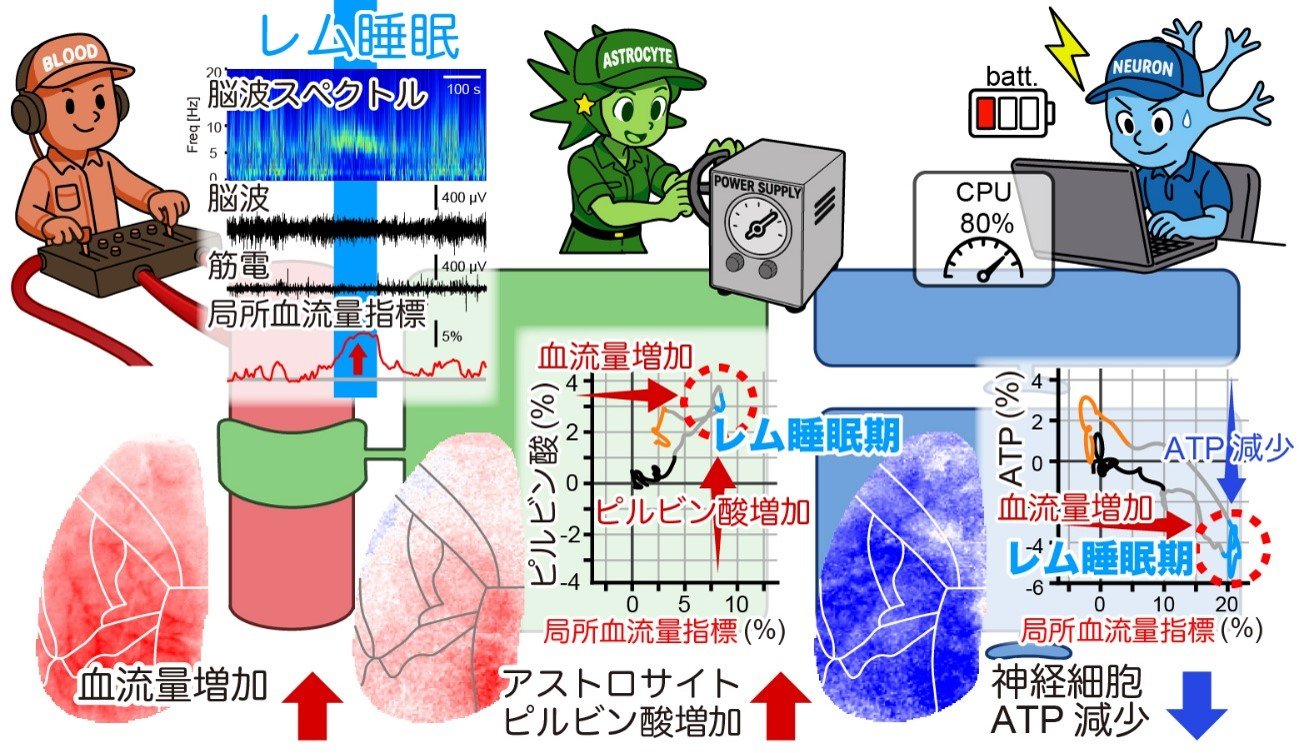
図1. 研究概要のイメージ
<関連情報>
- https://www.tohoku.ac.jp/japanese/2026/07/press20260728-03-ATP.html
- https://www.nature.com/articles/s42003-026-10646-6
レム睡眠におけるエネルギーのパラドックス:脳代謝における供給と消費のバランス Energy paradox in REM sleep: balancing supply and consumption in brain metabolism
Yusuke Takahashi,Yoko Ikoma & Ko Matsui
Communications Biology Published:27 July 2026
DOI:https://doi.org/10.1038/s42003-026-10646-6
Abstract
The brain’s capacity for information processing depends on precisely regulated energy dynamics. Yet how metabolic supply adapts to shifting computational demands across brain states remains unclear. Using wide-field fluorescence imaging through the intact skull of live mice, we simultaneously monitored brain blood volume (BBV), astrocytic pyruvate, and neuronal ATP levels during natural sleep. We found that large-scale metabolic dynamics are coupled to neuronal activity but reorganize in a state-dependent manner. During non-rapid eye movement (NREM) sleep, theta-band electrocorticogram (ECoG) activity predicted subsequent blood volume changes, accompanied by rapid anterior-to-posterior vascular waves. In contrast, REM sleep was marked by a pronounced increase in BBV, originating in the posterior cortex and slowly propagating across the brain. This was accompanied by elevated astrocytic pyruvate; paradoxically, however, neuronal ATP levels declined sharply. These findings reveal a dynamic interplay among neurons, astrocytes, and the vasculature, suggesting that distinct energy-allocation strategies underlie the brain’s computational flexibility.