
2026-09-28 スタンフォード大学
<関連情報>
- https://news.stanford.edu/stories/2026/09/california-school-menus-ultra-processed-foods
- https://www.cambridge.org/core/journals/public-health-nutrition/article/reducing-ultraprocessed-and-increasing-scratchcooked-school-meals-perceived-barriers-and-facilitators-from-food-service-directors/60E8FF0C3CB680C35CD53DA40E9A4EDC
超加工食品を減らし、手作りの学校給食を増やす:給食責任者が認識する障壁と促進要因 Reducing ultra-processed and increasing scratch-cooked school meals: perceived barriers and facilitators from food service directors
Andrea Pedroza-Tobias,Donna Matheson,Alix Zuceth Duran Gomez,Anjali Gupta,Aditi Sharma,Ashley De la Rosa,Deiglis Delgado,Genoveva Islas,Christina A. Hecht and Kenneth Hecht,….
Public Health Nutrition Published:28 September 2026
DOI:https://doi.org/10.1017/S1368980026103139
Abstract
Objective:
To examine school food service directors’ (FSD) perceived barriers and facilitators to increase scratch cooking as a strategy to reduce ultra-processed foods (UPF) in school meals.
Design:
A mixed-methods study design was used, incorporating semi-structured interviews and surveys. A Community Advisory Board provided input on the study design, interview guide and interpretation of results. Interviews were audio-recorded, transcribed verbatim, de-identified and double-coded. A hybrid thematic analysis was conducted, integrating emergent and a priori themes based on the socio-ecological model.
Setting:
California San Joaquin Valley, USA, from January to June 2024.
Participants:
Twenty FSD were randomly selected from a stratified sample of San Joaquin Valley school districts, categorised by locale (rural/urban) and whether they received a California supplementary funding award requiring at least 40 % of school meals to be freshly prepared.
Results:
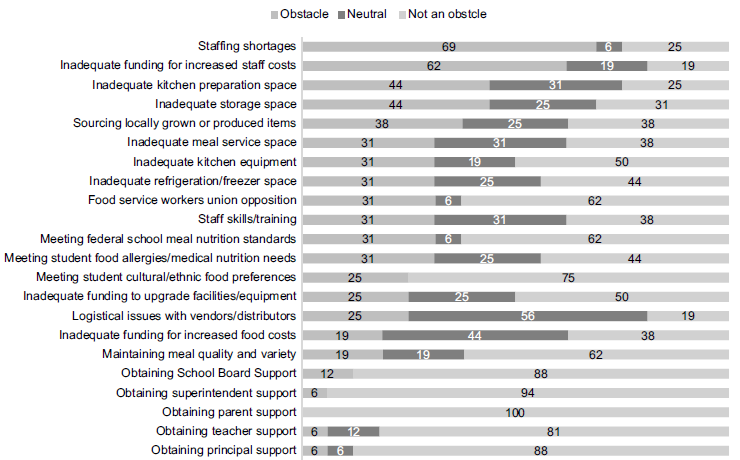
Key barriers to increasing scratch cooking in school meals included labour costs, staff shortages, inadequate kitchen infrastructure and food procurement challenges, with many districts relying on UPF. State and federal funding supported scratch cooking, but limited kitchen space and funding uncertainty hindered sustainable changes. While some FSD identified student preferences as a challenge, others described successful strategies to engage both students and parents to increase acceptance of scratch-cooked meals and boost participation in school meals.
Conclusions:
Given the current momentum at the federal, state and local levels to reduce UPF in school meals, this study provides timely insights to guide policies and practices that support the transition from UPF to scratch-cooked meals.

