2026-06-03 清華大学
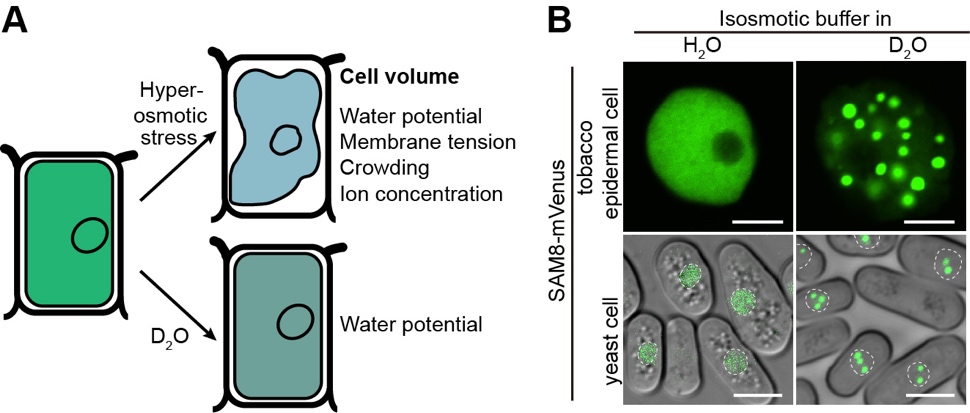
Figure 1. SAM8 undergoes water-dependent condensation. (A) Illustration of the impact of D₂O. (B) SAM8 forms condensation in cells on D₂O treatment.
<関連情報>
- https://www.tsinghua.edu.cn/en/info/1245/14932.htm
- https://www.nature.com/articles/s41586-026-10591-8
生体分子凝縮による細胞内水ポテンシャル感知 Cellular water-potential sensing through biomolecular condensation
Yunhe Wang,Longchen Zhu,Yun Yang,Xiaoshuang Li,Xin Zhang & Xiaofeng Fang
Nature Published:27 May 2026
DOI:https://doi.org/10.1038/s41586-026-10591-8
Abstract
Water molecules, as solvents for biomolecules, are essential to cells. The water potential of the cell decreases under water-deficient conditions1,2, yet how cells sense changes in water potential remains unknown. Here we identify a sterile alpha motif (SAM)-containing protein, SAM8, that undergoes water-potential-dependent condensation both in vivo and in vitro and is crucial for hyperosmotic stress tolerance and seed germination. We use biophysical techniques, in vitro reconstitution and bioimaging to demonstrate that SAM8 is strongly hydrated under normal water conditions, preventing its macroscopic condensation. A negatively charged patch determines SAM8 hydration by creating an electric field and micropolar environment. Water-deficient conditions weaken this hydration, thereby activating SAM8 condensation by reprogramming hydrogen bond, electrostatic and hydrophobic interactions. Furthermore, we demonstrate that SAM8 condensates selectively sequester RNA export factors, leading to nuclear retention of mRNAs and translational reprogramming under hyperosmotic stress. Our findings show a mechanism by which plant cells directly sense and respond to water status, shedding light on how they adapt to water deficit conditions.