2026-07-23 愛媛大学
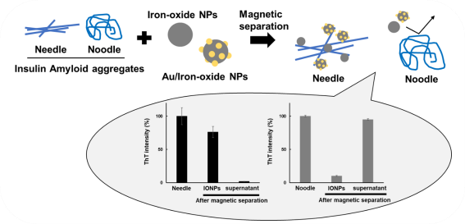
構造多型インスリンアミロイドと磁性ナノ粒⼦の吸着概略図
<関連情報>
- https://www.ehime-u.ac.jp/data_relese/pr_20260723_sci/
- https://www.sciencedirect.com/science/article/abs/pii/S0927775726017887
構造的に多形性を示すインスリンアミロイドへの磁性ナノ粒子の選択的吸着 Selective adsorption of magnetic nanoparticles to structurally polymorphic insulin amyloids
Ayato Hanazawa, Takahiro Watanabe, Mikael Lindgren, Satoshi Seino, Tamotsu Zako
Colloids and Surfaces A: Physicochemical and Engineering Aspects Available online: 5 July 2026
DOI:https://doi.org/10.1016/j.colsurfa.2026.141248
Abstract
Protein aggregation, particularly in the form of amyloid fibril formation, has been implicated in numerous pathological conditions. Among amyloid-forming proteins, insulin – a peptide hormone widely used in diabetes therapy, serves as a well-established model system for studying amyloid formation in vitro. Our previous work demonstrated that insulin assembles into two structurally distinct amyloid polymorphs: a highly cytotoxic fibrillar form (Needle) and a less cytotoxic a filamentous form (Noodle). Previous studies have also shown that magnetic nanoparticles (MNPs) can adsorb and magnetically separate amyloid fibrils. However, it remains unclear whether structurally distinct amyloid polymorphs exhibit different interactions and adsorption behaviors toward MNPs. In the present study, we demonstrate that insulin amyloid polymorphs can be selectively separated on the basis of their structure using MNPs. The Needle polymorph exhibits strong adsorption onto both iron-oxide nanoparticles (IONPs) and Au-decorated iron-oxide nanoparticles (Au/IONPs), whereas the Noodle polymorph shows negligible affinity for these nanoparticle surfaces. A comprehensive set of physicochemical analyses – including zeta potential measurements, pH and ionic strength dependence studies, circular dichroism (CD) spectroscopy and fluorescence assays, revealed that the observed selectivity cannot be explained primarily by electrostatic forces, hydrophobic interactions, or hydrogen bonding. Instead, it could be governed by subtle polymorphism-dependent differences in surface topology and residue exposure. These findings provide new insights into polymorph-specific nano–bio interfacial interactions and highlight the potential of nanoparticle-based platforms for the selective separation and detection of amyloid aggregates e.g., as biomarkers in clinical situations.