2026-06-10 サントリー生命科学財団
<関連情報>
- https://www.sunbor.or.jp/news/20260610/
- https://www.sunbor.or.jp/wp/wp-content/uploads/2026/06/NEWS20260610_ゴマPNAS.pdf
- https://www.pnas.org/doi/10.1073/pnas.2605774123
発芽期における酸素化とグルコシル化の協調を介したゴマのリグナン代謝の動的な多様化 Dynamic diversification of lignan metabolism in sesame via coordinated oxygenation and glucosylation across germination
Erisa Harada, Yukie Ohba, Eiichiro Ono, +11 , and Manabu Horikawa
Proceedings of the National Academy of Sciences Published:June 5, 2026
DOI:https://doi.org/10.1073/pnas.2605774123
Significance
Lignan metabolism in sesame (Sesamum indicum) serves as a valuable model for investigating how plants adapt their specialized metabolism. Although previous studies have focused on seed development, metabolic changes occurring during germination remain poorly characterized. Herein, we identify cytochrome P450 enzymes and UDP-glycosyltransferases that coordinate oxidative and glucosylation steps in lignan transformation during germination. Results demonstrate how structurally similar but functionally distinct enzyme paralogs expand lignan diversity through broad substrate recognition and regio-specific modifications. The finding that sesame uses distinct enzymatic systems to achieve same metabolic outcomes in seeds and seedlings underscores evolutionary flexibility of plant metabolism. This work offers molecular insights into how plants regulate specialized metabolites in response to developmental cues and environmental changes.
Abstract
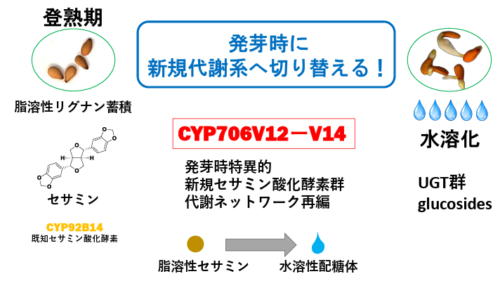
Sesame (Sesamum indicum) seeds accumulate specialized lignans, including (+)-sesamin, (+)-sesamolin, and (+)-sesaminol triglucoside (SL-TG). Although lignan biosynthesis during seed development is well characterized—with SiCYP92B14 recognized as a (+)-sesamin-specific oxygenase—the molecular basis of the metabolic transition during germination, where lipophilic lignans are fully converted into glucosides, remained unclear. Herein, we identify a set of (+)-sesamin oxygenases, SiCYP706V12–V14, cytochrome P450 enzymes (CYPs) that exhibit a broader substrate range than SiCYP92B14. These enzymes oxidize (+)-sesamin and (+)-sesamolin during germination; when acting on (+)-sesamin, SiCYP706V12 produce (+)-sesaminol, whereas SiCYP706V13 and SiCYP706V14 yield (+)-episesaminone. The resulting oxidized lignans are then sequentially and regio-specifically glucosylated by UDP-glycosyltransferases (UGTs), including SiUGT73E4 and SiUGT73CH10 identified in this study, together with previously characterized UGTs. Functional and kinetic analyses revealed that these UGTs differentially process lignans with distinct molecular structures, thereby contributing to glycoside diversity. Notably, analysis of an SL-TG-deficient sesame line indicates that SiCYP706V12, rather than SiCYP92B14, plays a key role in SL-TG biosynthesis during seed development. Yeast two-hybrid assays revealed a physical interaction between SiCYP706V12 and a downstream UGT, suggesting a possible functional association between these enzymes in lignan metabolism. This underscores the overlapping yet distinct roles of CYP and UGT enzymes in coordinating lignan metabolism from seed development through germination. Our work highlights biochemical evolvability as a key factor in the specialization of plant metabolism in response to developmental and environmental cues.