2026-06-09 神奈川県立産業技術総合研究所
<関連情報>
- https://www.kistec.jp/aboutus/press/pr20260609/
- https://www.kistec.jp/kistec-manage/wp-content/uploads/press_0609.pdf
- https://pubs.acs.org/doi/10.1021/acssensors.5c04942
ヒト尿中の癌関連化合物の気相検出のための細胞ベースマルチセンサーアレイ Cell-Based Multisensor Array for Vapor-Phase Detection of Cancer-Related Compounds in Human Urine
Hisatoshi Mimura,Toshihisa Osaki,Haruka Oda,Sho Takamori,Yuki Kodama,Norio Sasaoka,Yasuhiko Takahashi,and Shoji Takeuchi
ACS Sensors Published: June 10, 2026
DOI:https://doi.org/10.1021/acssensors.5c04942
Abstract
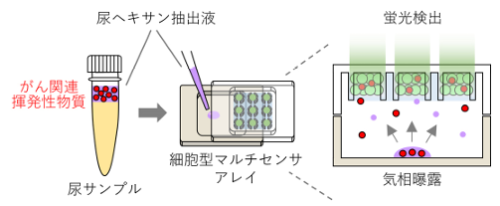
Detecting volatile biomarker candidates in complex biological samples is a key challenge in sensor science, particularly for noninvasive disease screening applications. Biohybrid sensors based on olfactory receptor-expressing cells offer high molecular selectivity; however, their use with physiological samples is often limited by weak fluorescence signals and variability in cellular responses. Here, we present a cell-based multisensor platform in which insect olfactory receptor-expressing cells are encapsulated in hydrogel and immobilized within slit-integrated microwells. This microstructural design enables dense three- dimensional cell loading and rapid, uniform exposure to target molecules, thereby enhancing fluorescence response sensitivity and reducing signal variability. The microwell architecture further allows simple and reproducible fabrication of multisensor arrays. Using this platform, multiple types of sensor cells on a single array enabled the selective and simultaneous detection of potential cancer-related volatile molecules, including acetophenone, phenol, and 6-methyl-5-hepten-2-one. By combining hexane extraction with vapor-phase exposure, we demonstrated reliable detection of acetophenone introduced into human urine samples at micromolar concentrations. The platform offers a compact, reproducible, and scalable strategy for cell-based detection of volatile molecules in complex biological samples.