2026-08-12 カリフォルニア大学リバーサイド校(UCR)
<関連情報>
- https://news.ucr.edu/articles/2026/08/12/vanillin-flavoring-e-cigarettes-disrupts-human-embryonic-stem-cell-development
- https://academic.oup.com/humrep/advance-article/doi/10.1093/humrep/deag126/8758908
電子タバコの香料であるナノモル濃度のバニリンは、TRPV4の活性化を介してヒト胚性幹細胞の多能性を阻害し、内胚葉分化を促進するようである Nanomolar vanillin, an e-cigarette flavorant, appears to disrupt pluripotency and promote endodermal differentiation in human embryonic stem cells via TRPV4 activation
Shabnam Etemadi,Prue Talbot
Human Reproduction Published:12 August 2026
DOI:https://doi.org/10.1093/humrep/deag126
Abstract
STUDY QUESTION
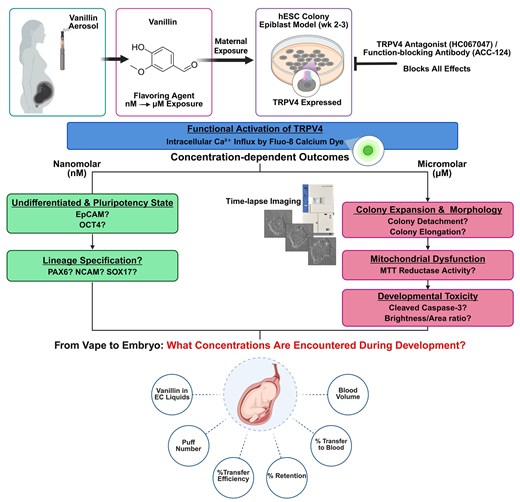
Does vanillin, at concentrations relevant to maternal exposures during vaping, disrupt gastrulation-related processes in human embryonic stem cells (hESCs) by activating TRPV4 channels?
SUMMARY ANSWER
Activation of TRPV4 channels by nanomolar concentrations of vanillin promoted an exit from pluripotency and a shift toward endodermal gene expression, while micromolar concentrations induced developmental toxicity, identifying a concentration-dependent mechanism by which vanillin, a flavoring agent in electronic cigarette (EC) aerosols, may pose risks to embryonic development during pregnancy.
WHAT IS KNOWN ALREADY
The use of ECs during pregnancy is increasing, potentially driven by perceptions of reduced harm and the appeal of flavoring agents, such as vanillin. However, vanillin activates transient receptor potential (TRP) channels, raising concerns about its impact on early embryonic development.
STUDY DESIGN, SIZE, DURATION
hESCs, which model the epiblast stage of development, were treated in vitro for various times with vanillin, a TRPV4 antagonist, a TRPV4 function-blocking antibody, or vanillin combined with either the antagonist or antibody. All experiments were done three times with different passages of stem cells.
PARTICIPANTS/MATERIALS, SETTING, METHODS
After variable periods of exposure, the hESC colonies were evaluated for activation of TRPV4 channels and calcium influx, colony growth, colony detachment, increased cell death, mitochondrial dysfunction, colony morphology, gap formation, downregulation of EpCAM, loss of pluripotency, and initiation of differentiation.
MAIN RESULTS AND THE ROLE OF CHANCE
We demonstrate that vanillin, at concentrations relevant to maternal EC exposure, significantly (P < 0.05) disrupted gastrulation-related processes in hESCs. hESCs, which model the epiblast during Weeks 2–3 of human development, exhibited TRPV4 channel expression and showed a significant increase in intracellular calcium upon nanomolar-to-micromolar vanillin exposure, as detected by the Fluo-8 calcium dye. Time-lapse imaging and quantitative analysis indicated that micromolar vanillin impaired colony expansion, induced colony detachment, and increased cell death over 72 h, while concurrently reducing mitochondrial reductase activity in the MTT assay. At nanomolar concentrations, vanillin promoted TRPV4 activation, an exit from pluripotency, downregulation of EpCAM cell adhesion protein, intercellular gap formation, and a shift toward endodermal gene expression. All effects were blocked by a TRPV4 antagonist (HC067047), identifying activation of this channel as a critical mediator of vanillin-induced toxicity.
LARGE SCALE DATA
N/A.
LIMITATIONS, REASONS FOR CAUTION
Our data are derived from in vitro experiments, as direct investigation of early human development is ethically and practically limited. Although our findings do not establish embryo lethality or malformation in vivo, the observed loss of pluripotency and SOX17 upregulation, consistent with endodermal induction, at nanomolar concentrations of vanillin are signs of early cellular perturbations that could compromise human development.
WIDER IMPLICATIONS OF THE FINDINGS
Nanomolar vanillin concentrations, which our exposure model estimates reach the embryo during early pregnancy in EC users, were sufficient to activate TRPV4 channels in hESCs and alter germ layer specification. Micromolar concentrations produced cytotoxic effects and increased cell death. These findings indicate that vanillin exposure at levels attainable during EC use disrupts intracellular Ca2+ homeostasis and compromises core processes of early human development. Maternal EC use during pregnancy therefore represents a significant and previously under-appreciated risk to early embryogenesis. Clinicians should counsel patients who are pregnant or planning pregnancy about this potential harm, and regulatory agencies should consider mandatory ingredient disclosure on EC packaging.
FUNDING
This research was supported by grant number T32IR4848 from the Tobacco-Related Disease Research Program (TRDRP), by grant number EDUC4-12752 from the California Institute of Regenerative Medicine (CIRM), and by UCR Yvonne Danielson Endowed Graduate and Dissertation Completion Fellowship Awards. The content is solely the responsibility of the authors and does not necessarily represent the official view of the TRDRP, CIRM, or UCR.
DISCLOSURES
The authors have no conflicts of interest to declare.