2026-09-02 東京科学大学
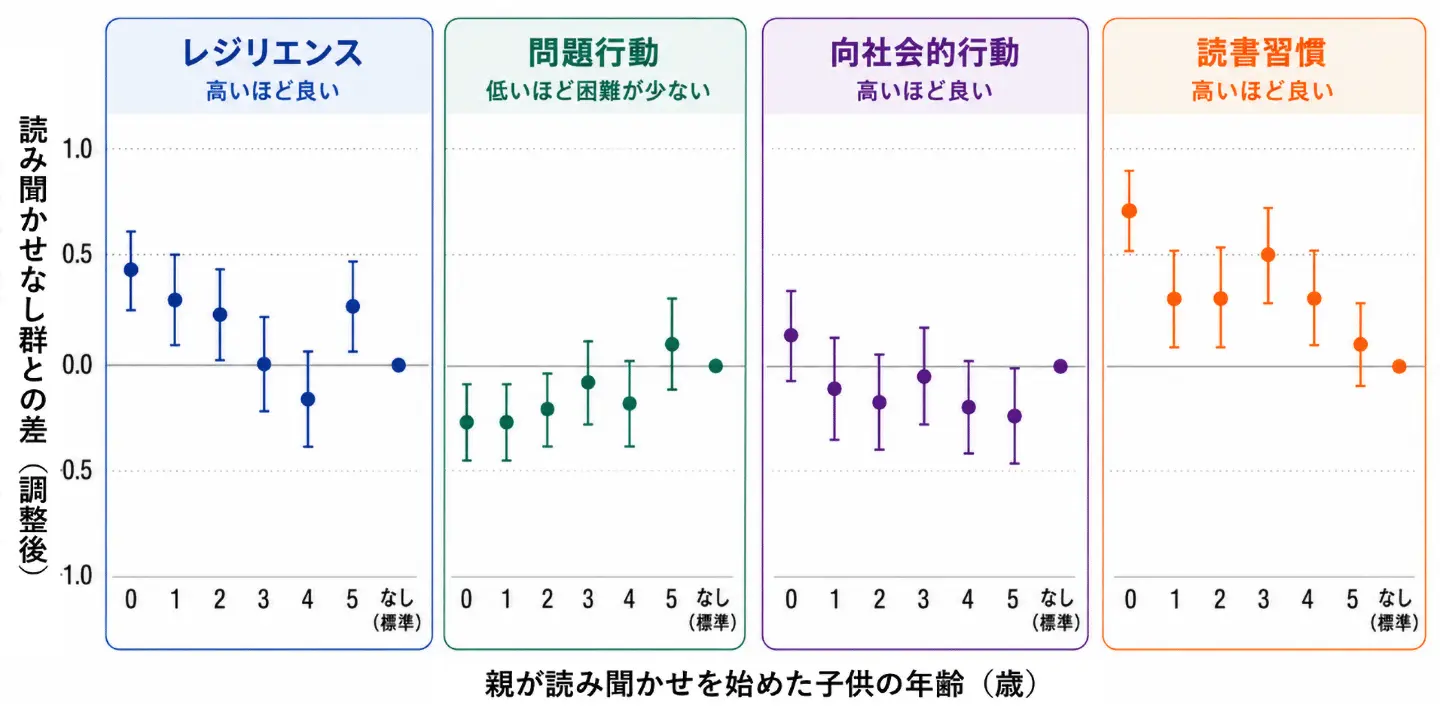
図1. 読み聞かせの開始年数と、小学1年生時の心の育ち・行動・読書習慣との関連
<関連情報>
幼児期の読み聞かせのタイミングと期間と、回復力、行動上の問題、読書習慣 Timing and duration of early-childhood shared reading and resilience, behavior problems, and reading habits
Shuhei Terada,Yui Yamaoka,Aya Isumi & Takeo Fujiwara
Pediatric Research Published:25 August 2026
DOI:https://doi.org/10.1038/s41390-026-05397-3
Abstract
Background
Shared parent–child reading is linked to literacy and socioemotional development, but whether initiation age is associated with outcomes beyond cumulative reading duration remains unclear. We examined initiation age and cumulative duration in relation to resilience, behavior problems, and reading habits among first-graders.
Methods
This population-based, cross-sectional analysis of A-CHILD II (2024) was conducted in all 67 public primary schools in Adachi City, Tokyo. We analyzed 2609 children aged 6–7 years. Shared reading at least weekly was reported annually from ages 0–5; exposures were summarized by initiation age and cumulative duration. Outcomes were caregiver-reported resilience, total difficulties, prosocial behavior, and reading habits.
Results
Shared reading began at age 0 for 64% of children; 8% had none. Compared with no shared reading, age-0 initiation was associated with lower total difficulties and higher resilience, prosocial behavior, and reading habits. Cumulative duration showed graded associations. Among children with 3 cumulative years, outcomes did not clearly differ by initiation age.
Conclusion
In this Japanese sample with relatively high parental education and household income, earlier initiation and longer duration were associated with more favorable outcomes. Cumulative duration appeared more consistently related to these outcomes than initiation age, although causal interpretation requires caution.
Impact
- In a Japanese population-based sample with relatively high parental education and household income, earlier initiation and longer cumulative duration of shared reading were associated with higher resilience, fewer total difficulties, greater prosocial behavior, and stronger reading habits among children aged 6–7 years.
- This study jointly evaluates initiation timing and cumulative duration, suggesting duration may be particularly important.
- Findings support discussing shared reading in health checkups, pediatric visits, and preschool settings as a feasible parent–child activity throughout early childhood, while generalizability and causal interpretation require caution.