2026-05-20 東京大学
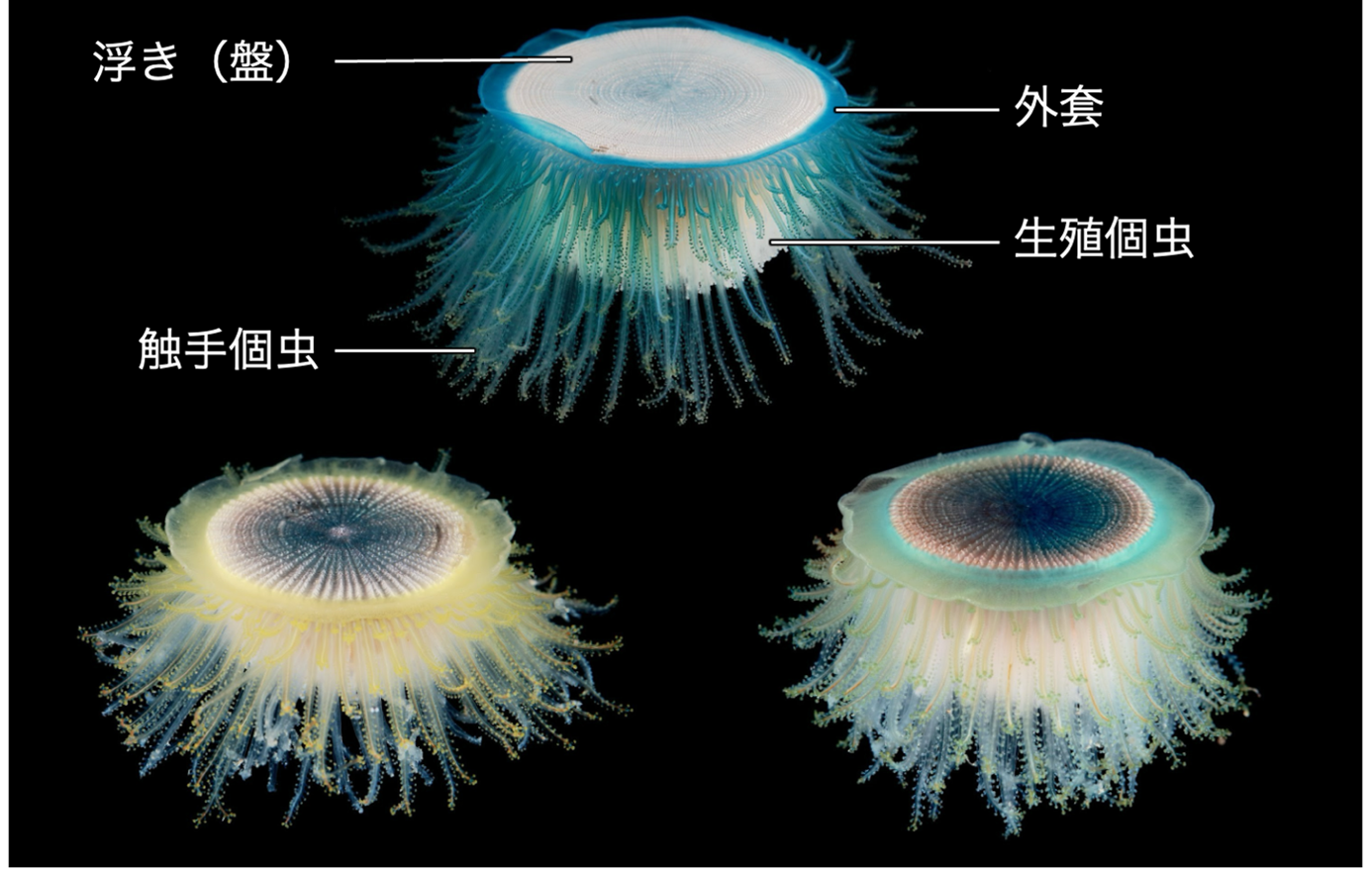
ギンカクラゲ
<関連情報>
浮遊性ヒドロ虫の一種であるポルピタ・ポルピタは、 1年以上漂流する A neustonic hydrozoan Porpita porpita drifts for over a year
Daiki Wakita,Kaho Murai,Gaku Yamamoto,Ryota Tamada,Hisanori Kohtsuka & Kohei Oguchi
Scientific Reports Published:20 May 2026
DOI:https://doi.org/10.1038/s41598-026-49897-y
Abstract
Neustonic organisms inhabiting the ocean surface have a unique ecology but remain poorly understood, particularly regarding longevity, due to difficulties in culturing and unpredictable occurrence. The blue button Porpita porpita is a colonial hydrozoan characterized by a chitinous, disc-shaped float that provides buoyancy and serves as the structural basis for zooid attachment, yet its growth and longevity have not been quantified. Here, we reared ten colonies for ≤ 21 days to measure float growth. Smaller colonies exhibited clear float enlargement, while larger colonies showed no detectable growth. Histology revealed peripheral accretion of new cuticular laminae at the float margin, suggesting margin-specific growth coupled to zooid budding. Based on the size-dependent decrease in growth rate, the observed radii were fitted with a Bayesian von Bertalanffy growth model. Estimated growth curves suggest that the sampled colonies persist for months to a few years, placing P. porpita on an intermediate timescale between short-lived scyphozoan medusae and long-lived benthic corals, and on a substantially longer lifespan than those previously reported for neustonic animals (< 1 year). These findings provide the first quantitative assessment of float growth in P. porpita, suggesting potentially long-term developmental strategy that enables colony persistence and contributes to a unique neustonic ecosystem.