2026-05-21 京都大学
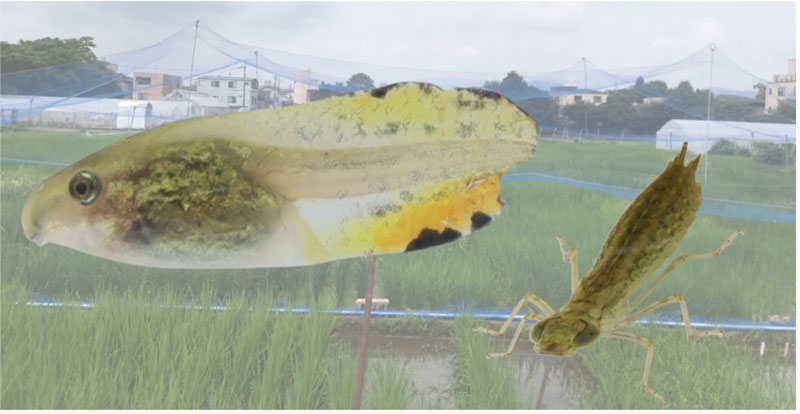
捕食者からの攻撃によってオレンジ色の尾が欠けてしまったヒガシニホンアマガエル幼生(左)と幼生のオレンジ色の尾を誘導する捕食者であるクロスジギンヤンマのヤゴ(右)、京都大学農学研究科附属農場・京都農場の風景(背景)。(撮影:野田叡寛)
<関連情報>
- https://www.kyoto-u.ac.jp/ja/research-news/2026-05-21-0
- https://brill.com/view/journals/amre/aop/article-10.1163-15685381-bja10258/article-10.1163-15685381-bja10258.xml
「おとり」のオレンジ: アマガエル属幼生における捕食者誘導性の橙色尾のルアー効果と攻撃偏向効果 A cloakwork orange: lure and deflection effects of predator-induced bright tail colouration in Dryophytes tadpoles
Akihiro Noda and Katsutoshi Watanabe
Amphibia-Reptilia Published:12 May 2026
DOI:https://doi.org/10.1163/15685381-bja10258
Abstract
Tadpoles of some amphibian species exhibit morphological and colour changes in response to predators. In several Dryophytes species (Hylidae), dragonfly nymphs induce the development of a deep, vivid orange tail. Previous studies using clay models have demonstrated that dark tail spots can function as lures that divert predator attacks away from the body. However, whether bright orange tails have similar effects, particularly when tested on live individuals, remains unknown. Here, we exposed predator-induced (Orange) and non-induced (Normal) tadpoles of Dryophytes leopardus to dragonfly nymphs of Anax nigrofasciatus and analysed strike locations from recorded videos. We found that orange-coloured tails were attacked more frequently than bodies of Orange individuals or the tails of Normal ones. Mortality rates did not significantly differ between individual types (Orange or Normal) or body parts attacked, probably owing to the limited space for tadpoles to escape. Nevertheless, strikes to orange tails were more likely to fail and leave tadpoles uninjured than strikes to either the bodies of Orange individuals or the tails of Normal ones. These findings suggest that the orange tail functions not only as a lure but also as a potential deterrent to reduce strike accuracy, possibly via motion dazzle effects. Thus, the orange tail may serve purposes beyond being merely a disposable part. The limited occurrence of such conspicuous tail colouration among amphibians may be explained by ecological and physiological constraints, such as increased vulnerability to non-focal predators or the higher developmental costs of expressing orange colouration except under specific resource acquisition conditions.