2026-06-09 京都大学
<関連情報>
- https://www.kyoto-u.ac.jp/ja/research-news/2026-06-09-1
- https://www.nature.com/articles/s41467-026-71375-2
ポナチニブはLCKおよびPI3Kシグナル伝達を阻害し、CD8 + T幹細胞記憶細胞の発達を促進するPonatinib inhibits LCK and PI3K signaling and promotes CD8+ T stem cell memory cell development
Yuki Okuhiro,Sachiko Ito,Keisuke Watanabe,Yue Yan,Kazuhiro Kumagai,Takahiko Sato,Yasuhiro Kojima,Yuki Fujioka,Naoto Takahashi,Hitoshi Kiyoi,Yuka Maeda,Takuma Kato & Hiroyoshi Nishikawa
Nature Communications Published:07 April 2026
DOI:https://doi.org/10.1038/s41467-026-71375-2
Abstract
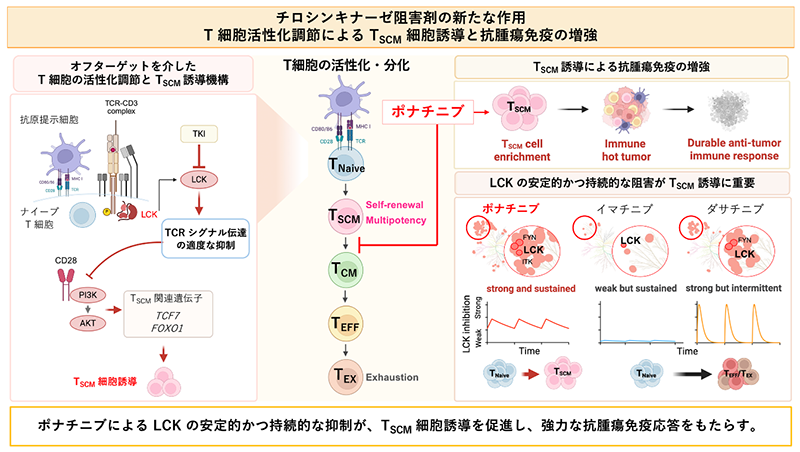
CD8+ T stem cell memory (TSCM) cells show clinical promise for cancer immunotherapy, but TSCM cell generation in clinical settings requires further optimization. Ponatinib is a tyrosine kinase inhibitor primarily targeting BCR-ABL1 and used for the treatment of chronic myeloid leukemia. Here, we investigate the effect of ponatinib on T cell activation and differentiation. Acting off-target, ponatinib inhibits LCK and PI3K signaling to enhance the transcriptional functions of TCF7 and FOXO1, thereby promoting CD8+ TSCM cell differentiation. Mechanistically, stable and sustained, but not intermittent, inhibition of the LCK and PI3K pathways is essential for CD8+ TSCM cell induction. In mouse tumor models, ponatinib treatment exhibits antitumor efficacy alone and in combination with PD-1 blockade. Furthermore, ponatinib increases chimeric antigen receptor (CAR) TSCM cells by reducing CAR T cell exhaustion, resulting in durable antitumor efficacy. Our results thus implicate ponatinib as therapeutic immunomodulator, inducing TSCM cells for improved antitumor T cell activity.