2026-06-09 東京科学大学
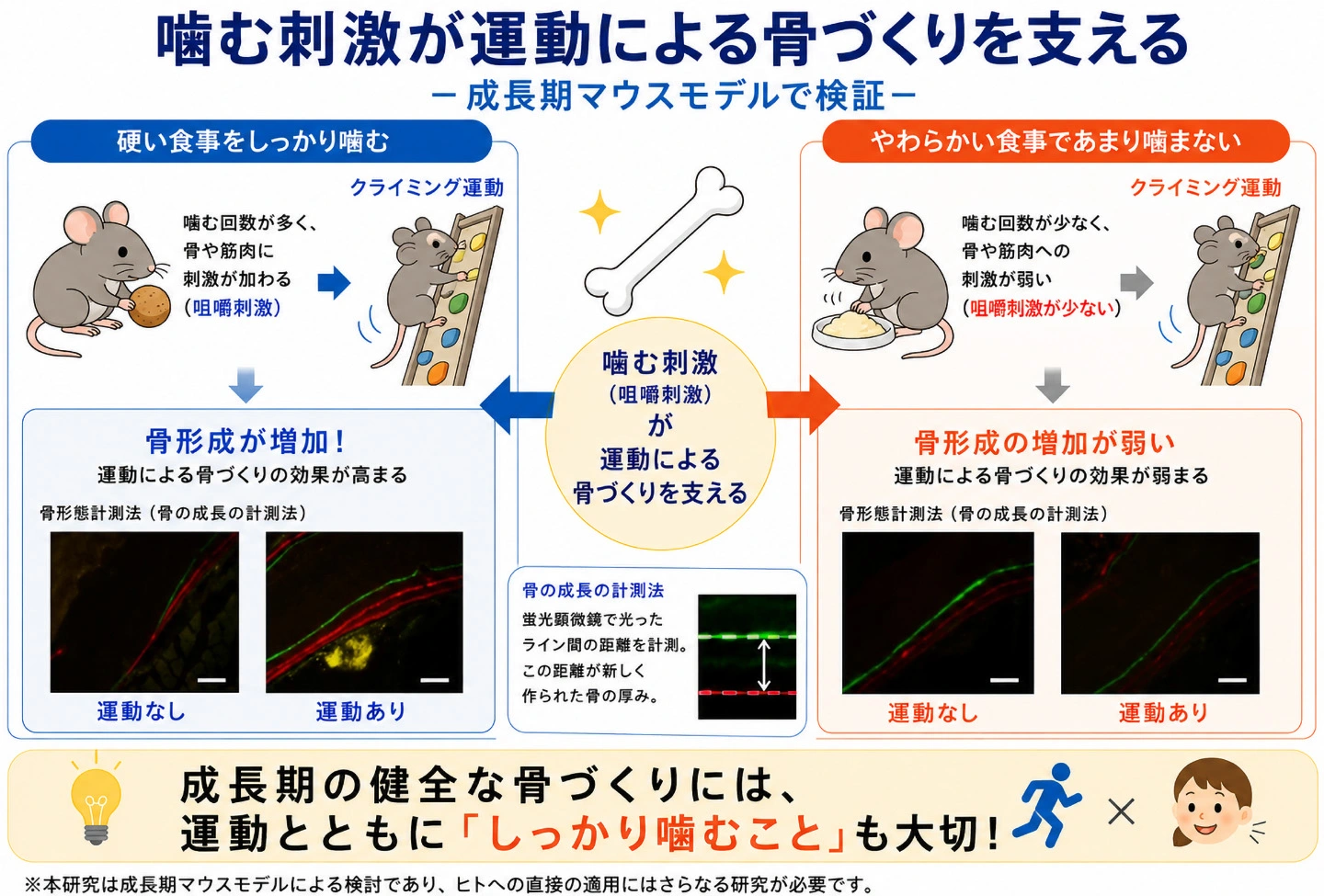
図1. 本研究の概要
硬い食事を与えたマウスでは、運動によって骨形成が増加した一方で、やわらかい食事を与えたマウスでは、運動による骨づくりの効果が弱まった。
<関連情報>
軟らかい食事は、成長期のマウスの長骨における運動誘発性の皮質骨密度および骨形成の増加を弱める A soft diet attenuates exercise-induced increases in cortical bone density and formation in long bones in growing mice
Yasuhiro Shimizu,Fatma Rashed,Huan Cao,Yuki Arai,Takashi Ono & Kazuhiro Aoki
Scientific Reports Published:21 May 2026
DOI:https://doi.org/10.1038/s41598-026-52803-1 Unedited version
Abstract
Bone and muscle are closely linked through functional interdependence. Training and regular exercise can improve and maintain optimal bone mass and strength. Here, we investigated the effects of exercise combined with soft versus hard diet (pellet) on long bones in mice. Four groups of male C57BL/6J mice (n = 5 per group) were studied: hard diet (pellet) with exercise, soft diet (powdered) with exercise, hard diet (pellet) without exercise, and soft diet (powdered) without exercise. Femur and tibia were analyzed using radiographic, micro-CT, and histomorphometric techniques. Exercise combined with a hard diet significantly increased cortical bone density, mineral apposition rate, and bone formation rate in long bones. In contrast, exercise with a soft diet attenuated these osteogenic responses, while bone resorption activity remained comparable across groups. Serum corticosterone levels were elevated in soft diet groups, whereas serum sclerostin levels were higher in hard diet exercise groups. Additionally, serum insulin-like growth factor-1 (IGF-1) was reduced in the soft diet exercise group compared with the hard diet exercise group. These results suggest that a soft diet compromises exercise-induced gains in bone mineral density and bone formation, highlighting the importance of masticatory stimulation in optimizing skeletal adaptation in the growth stage.