2026-06-09 ペンシルベニア州立大学(Penn State)
<関連情報>
- https://www.psu.edu/news/health-and-human-development/story/head-cooling-may-reduce-depression-symptoms-and-change-brain
- https://www.sciencedirect.com/science/article/pii/S0001691826006724
- https://www.frontiersin.org/journals/neurology/articles/10.3389/fneur.2023.1272374/full
- https://link.springer.com/article/10.1007/s11682-017-9755-2
選択的頭部冷却介入は精神健康指標を改善する:多角的実現可能性研究 Selective head cooling intervention improves mental health markers: A multimodal feasibility study
Zach Napora, Maddie McLaughlin, Owen Griffith, Laura Cooney, Elle McNally, Semyon M. Slobounov
Acta Psychologica Available online: 18 April 2026
DOI:https://doi.org/10.1016/j.actpsy.2026.106871
Abstract
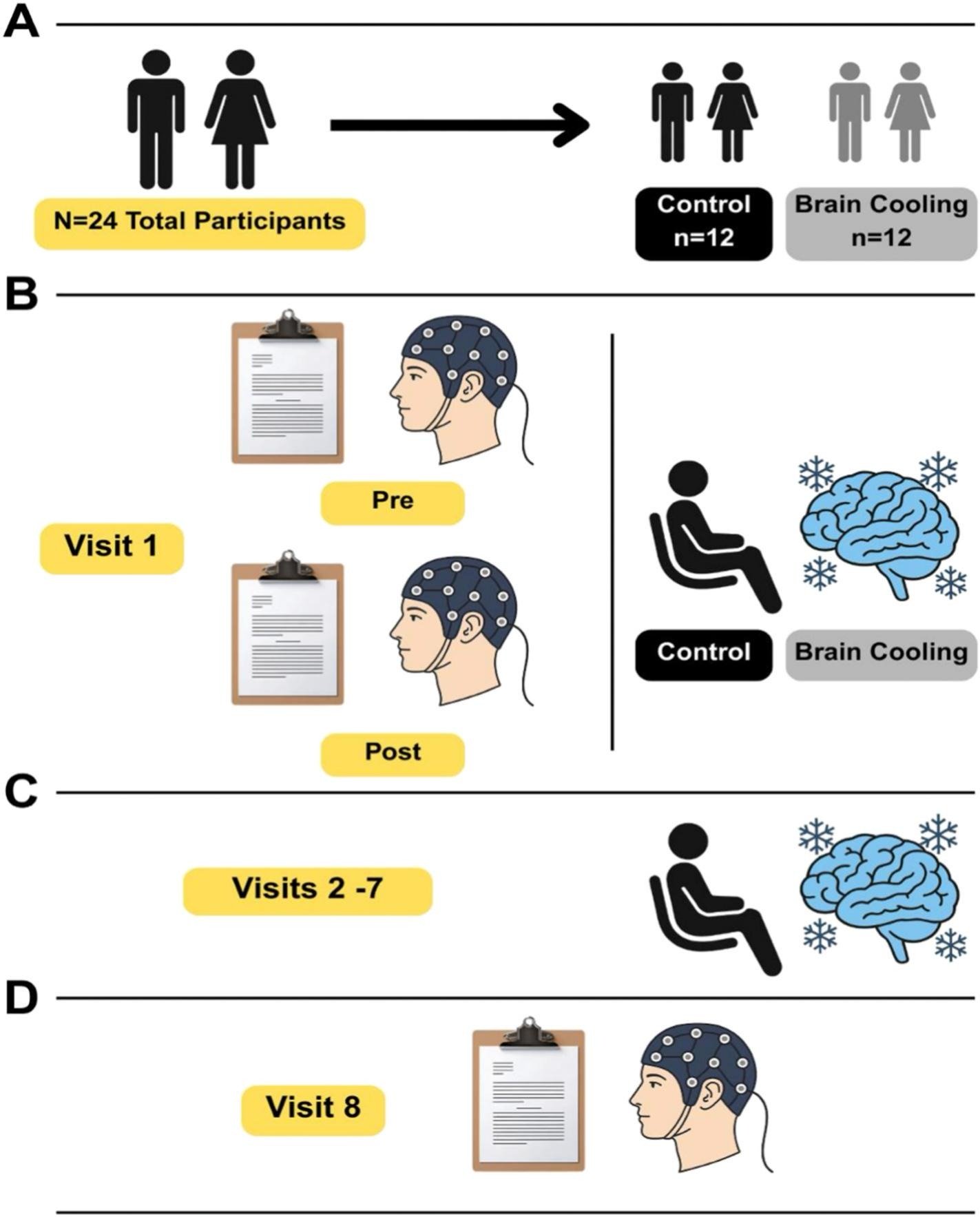
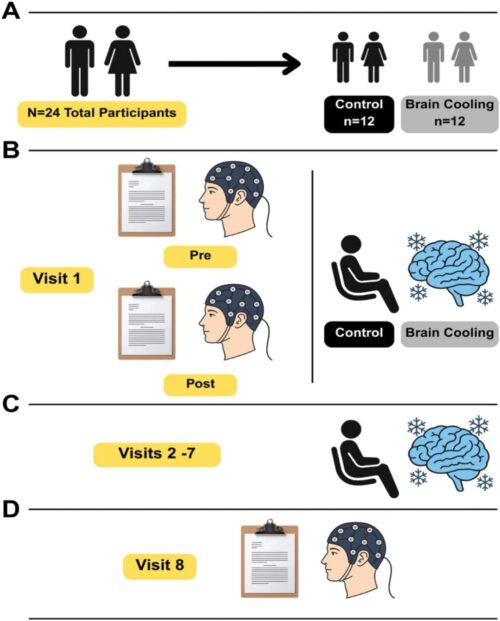
Selective head cooling has attracted increasing attention within brain research in the last decade, particularly for the purposes of psychophysiological symptom relief. Previous research has shown that head cooling after traumatic brain injury can assist in temporary symptom relief, the increase of cerebral blood flow, and the reduction of motor deficits. However, the effects of head cooling on mental health markers in individuals unaffected by traumatic brain injury are relatively unknown. We implemented a one-week intervention of head cooling and assessed cognitive function, mental health status, and electroencephalography patterns pre-intervention, acutely post-intervention, and longitudinally post-intervention, compared to controls. The head cooling group (mean = 4.053%, SD = 3.351) displayed a significantly greater change in relative alpha EEG power after acute head cooling compared to controls (mean = −0.053%, SD = 3.351) (p = 0.004). While both groups experienced reduced depression after the intervention period, the head cooling group (mean = −5.167, SD = 6.365) showed significantly greater symptom relief compared to the control group (mean = −0.500, SD = 1.960) (p = 0.020). An exploratory subgroup analysis revealed descriptive trends regarding the interaction of intervention group and preexisting anxiety diagnosis on treatment-related change of multiple EEG parameters. Overall, the study indicates that selective head cooling shows preliminary trends toward reducing depression symptoms and promoting brain activity related to relaxation in those with anxiety disorders, while significantly modulating EEG signals following repeated treatment.
脳震盪の急性期における選択的頭部冷却:神経画像研究 Selective head cooling in the acute phase of concussive injury: a neuroimaging study
Alexa E. Walter,Xiaoxiao Bai,James Wilkes,Thomas Neuberger,Wayne Sebastianelli,Semyon M. Slobounov
Frontiers in Neurology Published:27 October 2023
DOI:https://doi.org/10.3389/fneur.2023.1272374
Abstract
Introduction:
Neurovascular decoupling is a common consequence after brain injuries like sports-related concussion. Failure to appropriately match cerebral blood flow (CBF) with increases in metabolic demands of the brain can lead to alterations in neurological function and symptom presentation. Therapeutic hypothermia has been used in medicine for neuroprotection and has been shown to improve outcome. This study aimed to examine the real time effect of selective head cooling on healthy controls and concussed athletes via magnetic resonance spectroscopy (MRS) and arterial spin labeling (ASL) measures.
Methods:
24 participants (12 controls; 12 concussed) underwent study procedures including the Post-Concussion Symptom Severity (PCSS) Rating Form and an MRI cooling protocol (pre-cooling (T1 MPRAGE, ASL, single volume spectroscopy (SVS)); during cooling (ASL, SVS)).
Results:
Results showed general decreases in brain temperature as a function of time for both groups. Repeated measures ANOVA showed a significant main effect of time (F = 7.94, p < 0.001) and group (F = 22.21, p < 0.001) on temperature, but no significant interaction of group and time (F = 1.36, p = 0.237). CBF assessed via ASL was non-significantly lower in concussed individuals at pre-cooling and generalized linear mixed model analyses demonstrated a significant main effect of time for the occipital left ROI (F = 11.29, p = 0.002) and occipital right ROI (F = 13.39, p = 0.001). There was no relationship between any MRI metric and PCSS symptom burden.
Discussion:
These findings suggest the feasibility of MRS thermometry to monitor alterations of brain temperature in concussed athletes and that metabolic responses in response to cooling after concussion may differ from controls.
脳震盪後の選択的脳冷却の神経生物学的影響 Neurobiological effect of selective brain cooling after concussive injury
Alexa Walter,Katie Finelli,Xiaoxiao Bai,Brian Johnson,Thomas Neuberger,Peter Seidenberg,Timothy Bream,Mark Hallett & Semyon Slobounov
Brain Imaging and Behavior Published:15 July 2017
DOI:https://doi.org/10.1007/s11682-017-9755-2
Abstract
The search for effective treatment facilitating recovery from concussive injury, as well as reducing risk for recurrent concussion is an ongoing challenge. This study aimed to determine: a) feasibility of selective brain cooling to facilitate clinical symptoms resolution, and b) biological functions of the brain within athletes in acute phase of sports-related concussion. Selective brain cooling for 30 minutes using WElkins sideline cooling system was administered to student-athletes suffering concussive injury (n=12; tested within 5±3 days) and those without history of concussion (n=12). fMRI and ASL sequences were obtained before and immediately after cooling to better understanding the mechanism by which cooling affects neurovascular coupling. Concussed subjects self-reported temporary relief from physical symptoms after cooling. There were no differences in the number or strength of functional connections within Default Mode Network (DMN) between groups prior to cooling. However, we observed a reduction in the strength and number of connections of the DMN with other ROIs in both groups after cooling. Unexpectedly, we observed a significant increase in cerebral blood flow (CBF) assessed by ASL after selective cooling in the concussed subjects compared to the normal controls. We suggest that compromised neurovascular coupling in acute phase of injury may be temporarily restored by cooling to match CBF with surges in the metabolic demands of the brain. Upon further validation, selective brain cooling could be a potential clinical tool in the minimization of symptoms and pathological changes after concussion.