2026-045-23 ワシントン大学セントルイス校
<関連情報>
- https://source.washu.edu/2026/04/finding-predictability-in-the-teeming-world-of-bacteria/
- https://www.science.org/doi/10.1126/science.adr1440
微生物生態系における創発的予測可能性 Emergent predictability in microbial ecosystems
Jacob Moran, Lucas C. Graham, and Mikhail Tikhonov
Science Published:9 Apr 2026
DOI:https://doi.org/10.1126/science.adr1440
Editor’s summary
The concept of “emergent simplicity” is widely used in microbial ecology to enable predictions that work because of diversity not despite it. However, thus far, the field has been unable to reach a consensus on whether emergent simplicity is real, surprising, and useful. Moran et al. built a theoretical framework and applied it to data from two separate experiments on microbial communities assembled in the laboratory. The authors found that the complexity of species-function relations changed with community diversity. With more species, community function clustered in a simpler space. The authors describe how metabolic and physiological constraints can lead to this behavior. —Caroline Ash
Structured Abstract
INTRODUCTION
Microbial communities play essential roles in health and agriculture, yet predicting how a community’s composition determines its functional output remains a central challenge. Natural microbiomes are highly diverse, with many coexisting species and extensive functional redundancy, which generally makes quantitative modeling difficult. A long-standing hypothesis is that certain functional predictions might nevertheless be possible or even enabled by high diversity. However, this idea of “emergent simplicity” has remained loosely defined. Some studies have emphasized reproducibility rather than prediction; others have examined prediction without linking predictability to changing diversity; and some observed patterns may simply reflect statistical averaging. Therefore, it remains unclear what kind of nontrivial predictions diversity can enable.
RATIONALE
We have developed a framework to rigorously define and measure emergent simplicity with a focus on prediction. Our approach assesses how well community-level properties can be predicted from coarsened compositional descriptions, in which individual strains are grouped into broader functional classes. For each coarse description, we quantified its predictive power and its complexity, identifying the optimal trade-off between complexity and accuracy (the Pareto front). Comparing Pareto fronts across communities of differing richness allowed us to identify three distinct phenomena: (i) emergent reproducibility, in which properties vary less at higher richness; (ii) coarse-grainability, in which coarse descriptions are unexpectedly predictive at a fixed richness; and (iii) emergent predictability, in which coarse descriptions become increasingly predictive with richness. Using two published datasets, we tested whether these forms of emergent simplicity occur in laboratory-assembled ecosystems and whether they can be reproduced by standard theoretical models.
RESULTS
Across all five measured community properties—four fermentation products and the abundance of a focal strain—we observed that variability decreased with richness, confirming emergent reproducibility. However, randomized controls showed that this effect can arise from generic statistical averaging. All five properties also displayed coarse-grainability: Coarse descriptions were more predictive than null expectations; however, this too was expected, as even modest phylogenetic structure could reproduce such effects.
The key finding was that all properties exhibited emergent predictability. At higher richness, models of comparable complexity achieved higher predictive accuracy. This behavior was absent from standard ecological models, including consumer-resource and generalized Lotka-Volterra frameworks.
Analysis of functional measurements suggested that high-richness communities collapse onto lower-dimensional manifolds structured by physiological or environmental constraints, such as pH. We constructed a minimal model in which species modify, and are constrained by, a shared environmental variable. This was sufficient to generate emergent predictability. In our model, this phenomenon arose for biological rather than purely statistical reasons: The feedback opposed simple averaging along a dominant organizing axis, allowing coarse compositional features to become more informative.
CONCLUSION
Our results identify emergent predictability as a distinct and nontrivial form of emergent simplicity, supported by empirical data not accounted for in standard models. We described a mechanism in which physiological or environmental feedback can produce emergent predictability by structuring high-diversity communities along a small number of effective axes. This framework offers a path toward understanding and exploiting diversity-enabled predictability in complex microbial ecosystems.
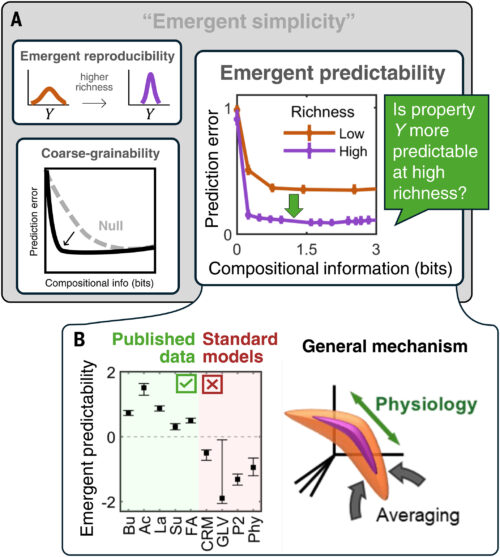
Higher richness, better predictions.
(A) An information-theoretic framework distinguishes three types of “emergent simplicity.” Two of these generically arise even in simple settings, but emergent predictability, in which simple models become more accurate at high community richness, is nontrivial. (B) Emergent predictability appears in published datasets but not in standard models, and we outline a candidate mechanism for its origin. Bu, butyrate; Ac, acetate; La, lactate; Su, succinate; FA, focal species abundance; CRM, consumer-resource model; GLV, generalized Lotka-Volterra model; P2, PICRUSt2-based traits; Phy, phylogenetically conserved traits.
Abstract
A long-standing hypothesis of microbial ecology is that simple patterns might persist despite community complexity or even emerge because of it. However, the concept of “emergent simplicity” remains partly intuitive. Here, we defined emergent predictability of microbial ecosystems based on the predictive power of coarsened descriptions that group individual microbial strains into broader classes. We used two published datasets to show that coarse descriptions became more predictive for more species-rich communities. This behavior was not explained by simple averaging effects in large communities. To the contrary, our analysis indicates that emergent predictability arises when physiological or environmental feedback counteracts these averaging effects along certain axes of community variation, allowing these axes to become more informative as diversity increases.