2026-05-09 中国科学院(CAS)
<関連情報>
- https://english.cas.cn/newsroom/research-news/202605/t20260509_1158647.shtml
- https://academic.oup.com/treephys/advance-article/doi/10.1093/treephys/tpag049/8661813
木部解剖構造とピット構造は、穿孔板の種類とは異なり、8種の木質マングローブにおける高塩分ストレスと干ばつストレスに対する水力戦略を形成する Xylem anatomy and pit architecture but not perforation-plate types shape hydraulic strategies against hypersaline and drought stress in eight woody mangroves
Yang Wei ,Xin Jiang ,Brendan Choat ,Amy Ny Aina Aritsara ,Kun-Fang Cao ,Ya-Jun Chen
Tree Physiology Published:24 April 2026
DOI:https://doi.org/10.1093/treephys/tpag049
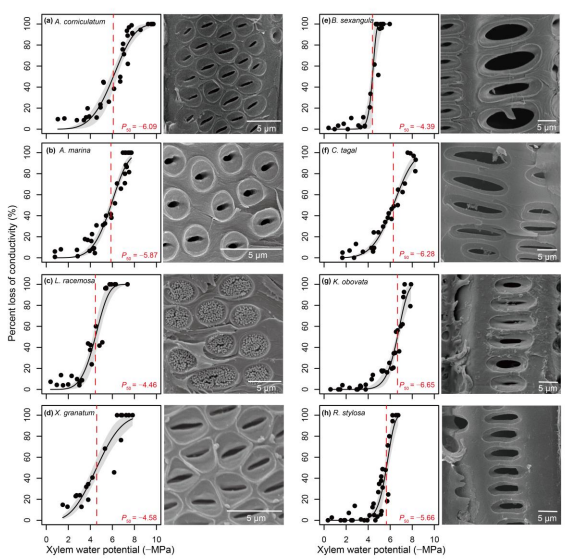
Figure 1. Stem vulnerability curves and scanning electron micrographs (SEM) of intervessel pit membranes for the eight woody mangrove species. Panels a-d indicate simple perforation-plate species, and panels e-h indicate scalariform perforation-plates species. Vertical dashed lines and values indicate xylem water potential inducing 50% loss of conductivity (P50). Shadow area indicates 95% confidence intervals of fitting.
Abstract
Mangrove species mainly inhabit tropical and subtropical intertidal zones, where they suffer periodic tidal inundation. They display diverse perforation-plate types and pit structures, however, the extent to which these anatomical features contribute to their adaptation to coastal environments remains unclear. In this study, we quantified 27 traits, representing hydraulics, anatomy, and pit characteristics in eight woody mangrove species from Hainan, Southern China, including four simple-perforation (SI) and four scalariform-perforation (SC) plate species. All species exhibited high xylem embolism resistance (P50: −4.39 to −6.65 MPa) but relatively low hydraulic efficiency (Ks-max: 0.65 to 1.87 kg m−1 s−1 MPa−1). We found an overall trade-off between hydraulic safety and efficiency, species with greater embolism resistance had narrower conduits, thicker vessel walls, and higher fractions of axial parenchyma. These species also exhibited more negative minimum water potentials (Ψmin: −2.90 to −3.98 MPa) and wider hydraulic safety margins (HSM50: 1.56 to 3.01 MPa) than species with lower embolism resistance. Although no significant differences were observed in hydraulic function or most xylem anatomy between SI and SC species, likely due to substantial within-group variations, pit architecture differed markedly. SI species had smaller, more densely packed pits compared to SC species. Additionally, variations in pit aperture size and shape well explained interspecific differences in hydraulic safety but not hydraulic efficiency. Our findings highlight that enhanced hydraulic safety, rather than efficiency, underpins mangrove adaptation to hypersaline environment through reinforcement both anatomical and pit architecture. While perforation plate morphology influences pit architecture, it does not appear to affect hydraulic function directly. Further research, including a broader taxonomic range, is necessary to clarify how variations in perforation-plate types modulate hydraulic performance.