2026-05-29 北海道大学
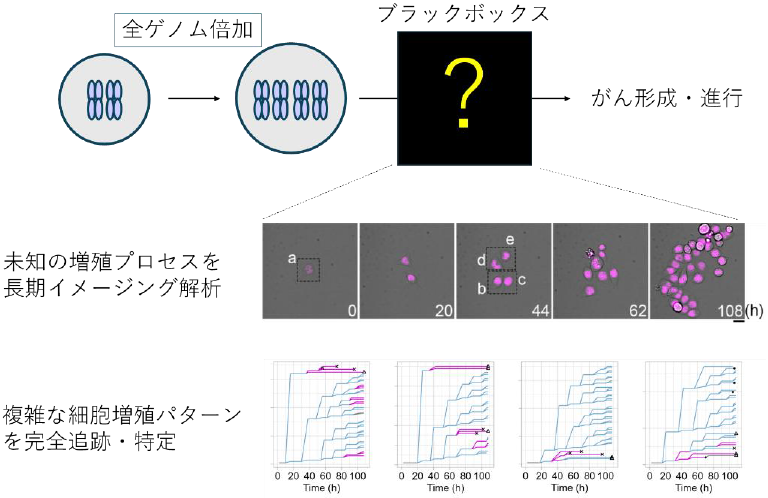
がん形成・進行の要因となる全ゲノム倍加細胞の複雑な増殖プロセスを、長期ライブイメージング及び系譜解析により特定し、特徴的なパターンに分類した。
<関連情報>
- https://www.hokudai.ac.jp/news/2026/05/post-2303.html
- https://journals.biologists.com/bio/article/15/5/bio062568/371779/Profiling-cell-proliferation-after-whole-genome
ヒト細胞における全ゲノム倍加後の増殖パターンの解析 Profiling cell proliferation after whole-genome duplication in human cells
Guang Yang,Masaya Inoko,Kaito Ogura,Sumire Ishida-Ishihara,Yuki Tsukada,Akira Funahashi,Masanao Sato,Ryota Uehara
Biology Open Published:26 May 2026
DOI:https://doi.org/10.1242/bio.062568
ABSTRACT
Though whole-genome duplication (WGD) contributes to cancer progression, the mechanism of post-WGD cell proliferation remains unclear. Here, using 6-day live-imaging, we analyzed the proliferation dynamics of more than 150 post-WGD HCT116 cell lineages. A quantitative comparison of mitotic patterns and cell fates between proliferative and non-proliferative lineages revealed that multipolar chromosome segregation in early mitosis is a potential key factor limiting the proliferative capacity of post-WGD progenies. Multipolar chromosome segregation correlated with suppressed post-WGD cell viability, particularly when accompanied by drastic chromosome loss or when it repeatedly occurred. Tracing proliferative lineages elucidated that they proliferated mainly by imposing the risk of multipolar chromosome segregation on one of two sub-lineages that formed after the first bipolar division. Meanwhile, a considerable proportion of proliferative lineages consisted entirely of progeny of early multipolar chromosome segregation events. Our results highlight key cellular events that determine the proliferation dynamics and diversity of post-WGD progenies, providing a fundamental reference for understanding WGD-associated biological processes.