2026-05-28 東京大学
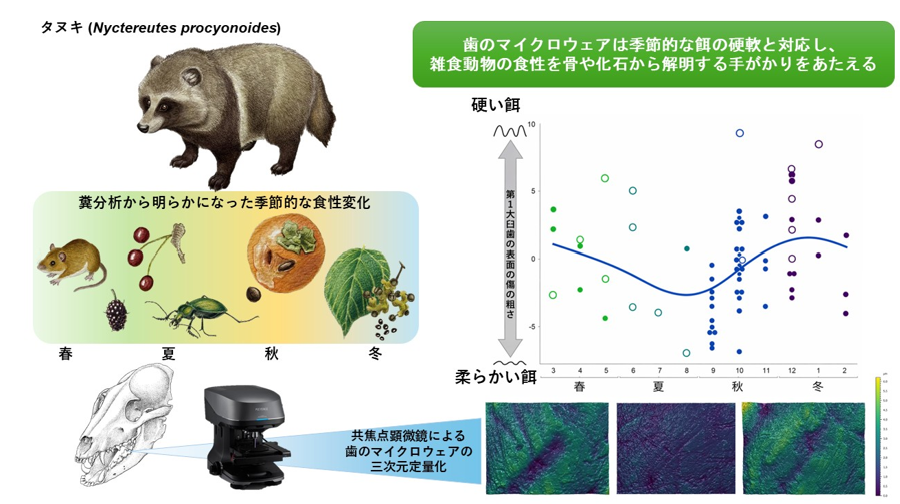
本研究成果のまとめ(タヌキとその餌のイラスト©成田あむ)
<関連情報>
- https://www.k.u-tokyo.ac.jp/information/category/press/0029996.html
- https://www.sciencedirect.com/science/article/pii/S0031018226003470
雑食性タヌキ(Nyctereutes procyonoides、イヌ科)における季節的な食性の柔軟性が歯の微細摩耗テクスチャ分析によって明らかになった:イヌ科動物の古生態学への示唆 Seasonal dietary flexibility in the omnivorous raccoon dog (Nyctereutes procyonoides, Canidae) revealed by dental microwear texture analysis: Implications for paleoecology of canids
Takahiro Takahashi, Ayako Kohno, Yamato Tsuji, Mugino O. Kubo
Palaeogeography, Palaeoclimatology, Palaeoecology Available online: 13 May 2026
DOI:https://doi.org/10.1016/j.palaeo.2026.113884
Highlights
- DMTA reveals seasonal dietary shifts in omnivorous raccoon dogs.
- Insect- and fruit-rich seasons show distinct microwear texture patterns.
- DMTA detects ontogenetic differences linked to bite force and jaw mechanics.
- Findings support seasonal diet reconstruction in fossil omnivorous canids.
Abstract
Dental microwear texture analysis (DMTA) is widely applied to reconstruct diets in herbivorous and carnivorous mammals, but its applicability to omnivorous canids remains insufficiently tested. Because omnivores consume foods with highly variable mechanical properties, it remains unclear whether DMTA can reliably detect seasonal and ontogenetic dietary variation in such taxa. Here, we evaluate the utility of DMTA in the raccoon dog (Nyctereutes procyonoides), a wild omnivorous canid inhabiting cool-temperate Japan. Three-dimensional enamel surface textures were analyzed from lower molars of road-killed individuals of known age and sex. Surface roughness varied seasonally, with smoother textures during periods of increased insect consumption and rougher textures during seasons characterized by greater fruit and vertebrate intake. Correlation analyses with independent fecal dietary data supported these trends, suggesting that DMT primarily reflects variation in the mechanical properties of dominant seasonal food resources. Age-related differences were also detected, as adults exhibited significantly rougher surfaces than juveniles, likely reflecting ontogenetic differences in bite force and feeding behavior. No significant sex-related differences were observed. These results demonstrate that DMTA can detect ecologically meaningful dietary variation in a wild omnivorous canid under natural conditions. By providing a modern ecological framework for interpreting dietary flexibility, this study supports the application of DMTA to fossil and archaeological canids and offers comparative insights into dietary transitions associated with environmental change, human proximity, and domestication processes.