2026-08-18 北海道大学,札幌市円山動物園
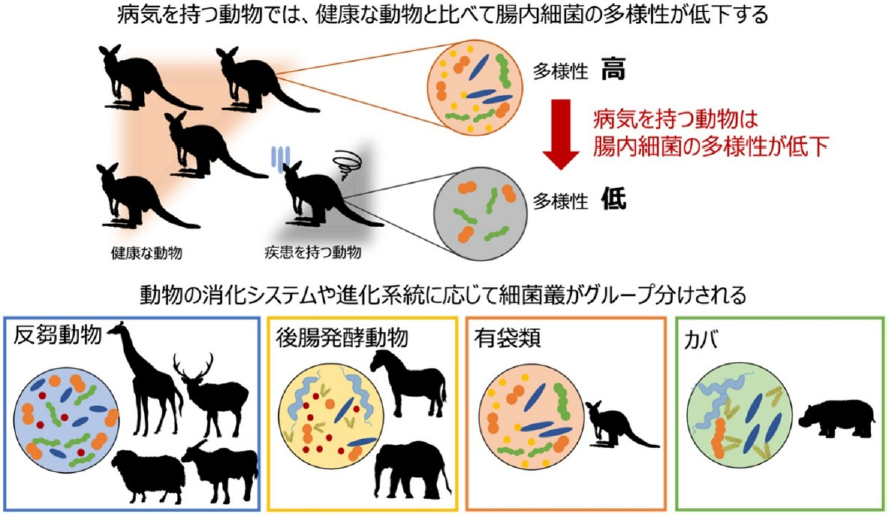
研究成果の概要図
<関連情報>
- https://www.hokudai.ac.jp/news/2026/08/post-2411.html
- https://bioone.org/journals/journal-of-zoo-and-wildlife-medicine/volume-57/issue-3/2025-0091/A-cross-sectional-survey-of-the-gut-microbiome-in-zoo/10.1638/2025-0091.full
動物園で飼育される草食動物の腸内細菌の横断的研究:健康個体群からの逸脱と個体の健康状態の関連 A cross-sectional survey of the gut microbiome in zoo-housed herbivores: associations between taxonomic deviations and individual health status
Keita Kakisaka, Yurie Taya, Naoki Hayashi, Mohamed Abdallah Mohamed Moustafa, Mackenzie L. Kwak, Nariaki Nonaka, Ryo Nakao
Journal of Zoo and Wildlife Medicine Published:13 August 2026
DOI:https://doi.org/10.1638/2025-0091
Abstract
The health management of zoo-housed animals is important. Although clinical examinations are essential for health monitoring of the animals, many of them exhibit noncooperative behavior during examinations. It is therefore necessary to develop noninvasive health monitoring tools. Gut microbiome analysis represents a novel approach to understanding the relationship between gut microbial flora and various diseases. However, the lack of information on the normal gut microbiome of zoo animals hinders the application of microbiome analysis for health management in animals. Therefore, this study aims to obtain insight on the gut microbiomes of eight different zoo-housed herbivorous animal species, including nine eastern gray kangaroos (Macropus giganteus), four Asian elephants (Elephas maximus), one eland (Taurotragus oryx), two plains zebras (Equus quagga), two hippopotamuses (Hippopotamus amphibius), four sika deer (Cervus nippon), five sheep (Ovis aries), and two giraffes (Giraffa camelopardalis). The bacterial composition in the fecal samples was determined using 16S rRNA gene-based amplicon sequencing. The results indicated that the two hindgut fermenters (elephants and zebras) had a significantly different gut microbiome composition from that of the foregut fermenters (kangaroo, eland, deer, sheep, and giraffe). In general, individuals of the same animal species were likely to have similar microbial communities. However, a few individuals demonstrated a distinct gut microbiome, with remarkably lower α-diversity than others in the same species. Subsequently, it was revealed that these individuals had underlying disorders, including systematic lymphoma, chronic emaciation, and rumen hypoplasia. This study is a first step toward understanding the role of the microbiome in animal health, and future studies will facilitate the application of microbiome analysis in animal health management in zoos.