2026-05-29 東北大学
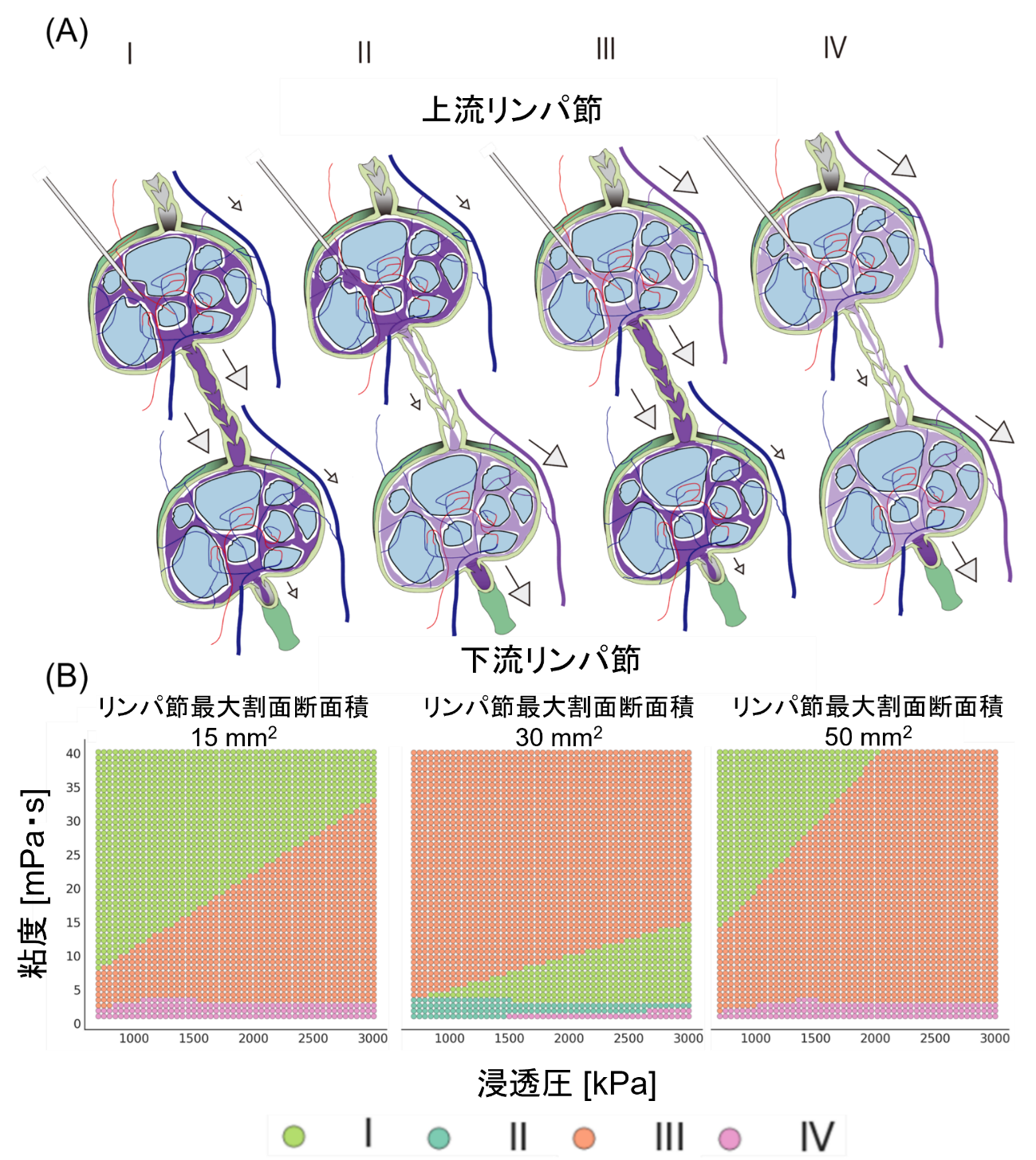
図1.LDDSの4パターン分類とリンパ節サイズに応じた薬剤貯留・送達予測マップ
<関連情報>
- https://www.tohoku.ac.jp/japanese/2026/05/press20260529-01-LDDS.html
- https://www.sciencedirect.com/science/article/pii/S016836592600413X
浸透圧、粘度、リンパ節サイズを用いたリンパ系薬物送達システムのモデル誘導設計 Model-guided design of lymphatic drug delivery systems using osmotic pressure, viscosity and lymph node size
Reito Miyazaki, Ariunbuyan Sukhbaatar, Shiro Mori, Takahiro Kusaka, Katsunori Katagiri, Kiyoto Shiga, Tetsuya Kodama
Journal of Controlled Release Available online: 12 May 2026
DOI:https://doi.org/10.1016/j.jconrel.2026.115010
Highlights
- A quantitative framework that links osmotic pressure, viscosity, and lymph node size in lymphatic drug delivery system.
- Deep-learning surrogate modeling predicts entire intranodal concentration-time profiles.
- Downstream lymphatic transport exhibits two discrete, classifiable Tmax regimes.
- An LDDS strategy map enables inverse formulation design for N0 lymph nodes.
- Early human lymphatic transport dynamics are consistent with model prediction.
Abstract
Metastatic lymph nodes (LNs) represent a major barrier to effective drug delivery in cancer therapy. To address this challenge, a lymphatic drug delivery system (LDDS) enabling direct intranodal administration has been developed. In LDDS, drug transport and retention are governed by formulation osmotic pressure and viscosity; however, optimization strategies according to LN size and therapeutic objectives remain unclear.
Here, we established a quantitative framework that integrates mathematical modeling with machine and deep learning to describe and predict intranodal drug kinetics as a function of osmotic pressure, viscosity and Maximum cross-sectional area of LN (MALN). Using a unique mouse model possessing human-sized LNs, we first constructed a parametric model that accurately reproduced fluorescence intensity profiles in LNs. The model captured key kinetic features and is enabled to apply time-series datasets. A multilayer perceptron–based surrogate model was then trained to predict C(t) profiles and pharmacokinetic parameters across the entire π–μ–MALN space. In parallel, downstream LN transport exhibited two distinct Tmax phenotypes, which were successfully classified using machine learning to evaluate network-level delivery efficiency.
Importantly, comparison with clinical LDDS data demonstrated that the model also describes early drug kinetics in human LNs. Because this framework relies only on clinically accessible LN size information, it enables inverse design of osmotic pressure and viscosity tailored to LN size and desired delivery outcomes. This study provides a mechanistically grounded and translatable strategy for rational LDDS formulation design to support controlled lymphatic drug delivery in future clinical applications.