2026-07-21 東北大学
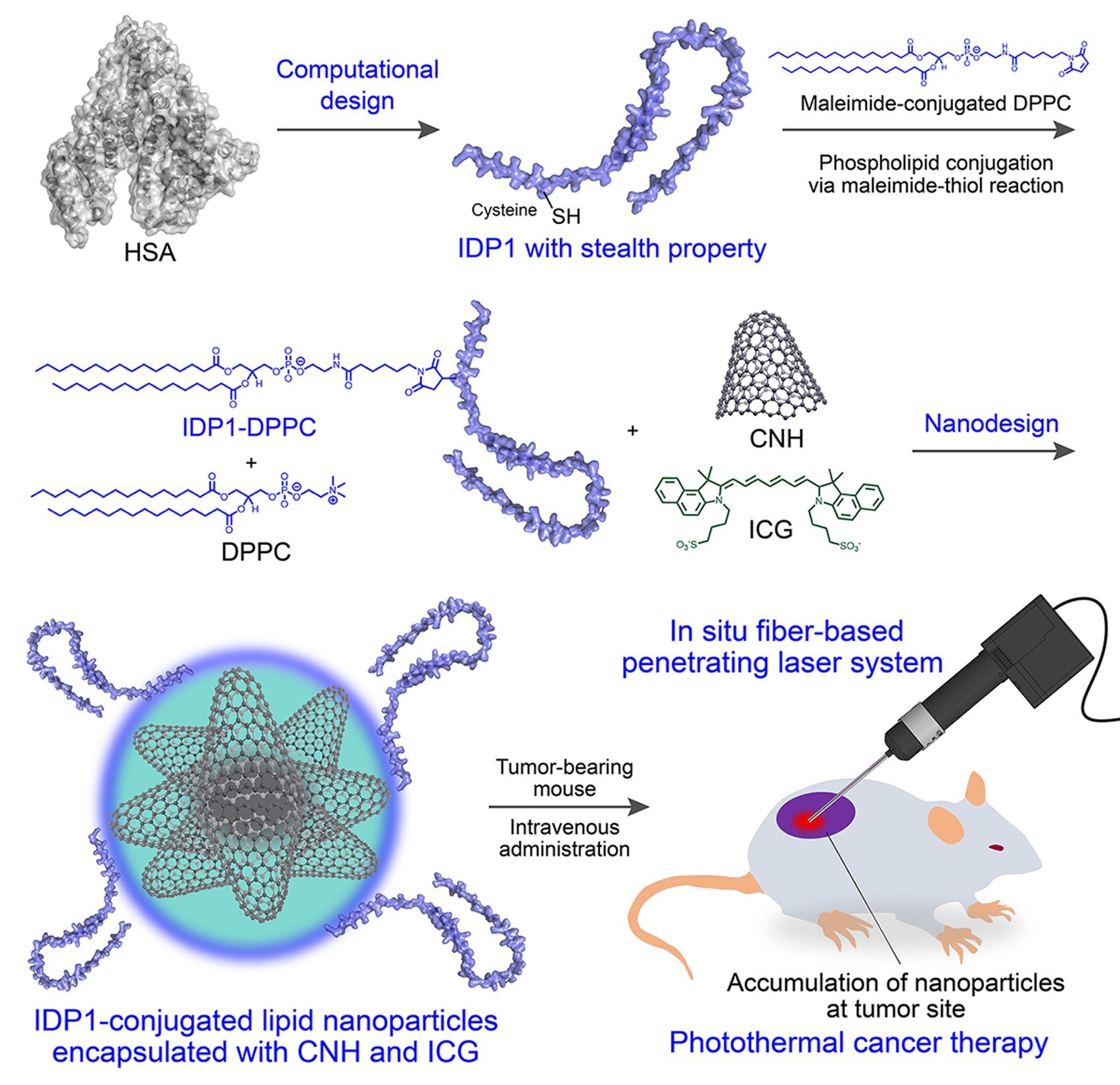
図1. 本研究の概要。ヒト血清アルブミンからコンピュータで設計した人工タンパク質IDP1でコーティングした光熱変換ナノ粒子(IDP1-CNH/ICG)を静脈投与し、注射針サイズの極細硬性内視鏡を腫瘍内に挿入して直接レーザを照射することで、効率的な光熱がん治療を実現した。
<関連情報>
- https://www.tohoku.ac.jp/japanese/2026/07/press20260721-01-AI.html
- https://onlinelibrary.wiley.com/doi/10.1002/smsc.70342
本質的に無秩序なポリペプチドをベースとしたステルス材料により、in situファイバーベースの透過型レーザーシステムを用いた光熱がん治療の強化が可能になる Intrinsically Disordered Polypeptides-Based Stealth Materials Enable Enhanced Photothermal Cancer Therapy Using an In Situ Fiber-Based Penetrating Laser System
Kei Nishida, Hiromasa Yamashita, Akira Takahashi, Eijiro Miyako
Small Science Published: 14 July 2026
DOI:https://doi.org/10.1002/smsc.70342
Abstract
Photothermal therapy has emerged as a minimally invasive cancer treatment strategy, yet poor nanoparticle (NP) stability, nonspecific accumulation, and inefficient laser delivery to deep tumor tissues markedly limit conventional approaches. Here, we report the rational design of intrinsically disordered polypeptides (IDPs) as next-generation stealth materials for photothermal cancer therapy applications using a novel contact-mode laser irradiation system. IDP1 was computationally designed as a hydrophilic IDP inspired by albumin’s primary sequence. IDP1 exhibited an exceptional fourfold prolonged blood circulation half-life (t1/2 = 150.5 min) relative to PEG (t1/2 = 17.8 min). IDP1-conjugated lipid NPs encapsulating carbon nanohorns and indocyanine green (IDP1-CNH/ICG) demonstrated efficient tumor accumulation via the enhanced permeability and retention effects. We developed a graded-index plastic optical fiber endoscope system with integrated real-time fluorescence imaging capability, enabling image-guided contact-mode near-infrared laser irradiation and achieving superior photothermal conversion compared to conventional noncontact irradiation, representing 27% higher heating efficiency. In Colon26-bearing mice, complete tumor regression occurred within 14 days after single-dose IDP1-CNH/ICG administration combined with contact-mode laser irradiation, without recurrence or systemic toxicity. Overall, this study establishes IDP1 as versatile stealth biomaterials and demonstrates the synergistic potential of advanced NP design with innovative laser delivery systems for effective cancer therapy.