2026-07-21 総合科学研究機構,高エネルギー加速器研究機構,J-PARCセンター,九州大学
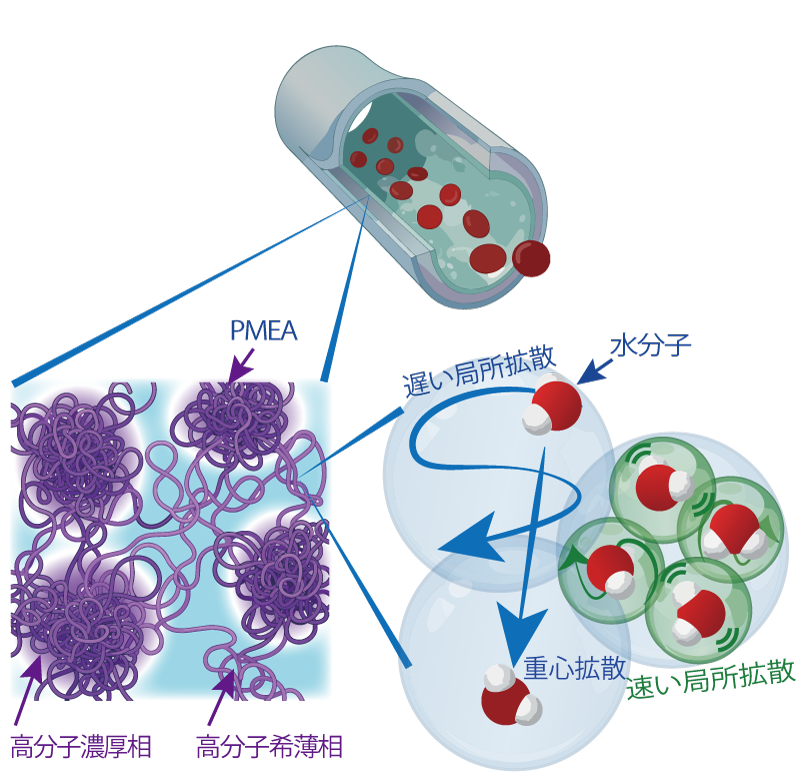
図 中間水の運動の様子の模式図。
<関連情報>
- https://neutron.cross.or.jp/ja/news/outcomes/pt20260721-51361.html
- https://pubs.acs.org/doi/10.1021/acs.jpcb.6c02094
生体適合性ポリ(2-メトキシエチルアクリレート)中の中間水分子の動態を準弾性中性子散乱法によって明らかに Dynamics of Intermediate Water in Biocompatible Poly(2-methoxyethyl acrylate) Revealed by Quasi-Elastic Neutron Scattering
Hideki Seto,Daiki Murakami,Taiki Tominaga,Shohei Shiomoto,and Masaru Tanaka
The Journal of Physical Chemistry B Published: June 25, 2026
DOI:https://doi.org/10.1021/acs.jpcb.6c02094
Abstract
Biocompatible polymers play a critical role in biomedical devices. A prominent example is poly(2-methoxyethyl acrylate) (PMEA), the biocompatibility of which is attributed to the presence of “intermediate water”, which exhibits physical properties distinct from bulk water. Although various methods have investigated intermediate water features, the fundamental origin of its formation remains elusive. In this study, quasi-elastic neutron scattering was employed in combination with selective deuteration to independently investigate the dynamics of water molecules and PMEA chains. Our results resolved four modes of water motion: global diffusion, slow local diffusion, fast local diffusion, and molecular reorientation. This dynamics hierarchy aligns with the behaviors reported for poly(ethylene oxide); however, the PMEA hydration water molecules exhibit enhanced localization due to the microphase separation within the PMEA-water system.