2026-08-21 東北大学
小
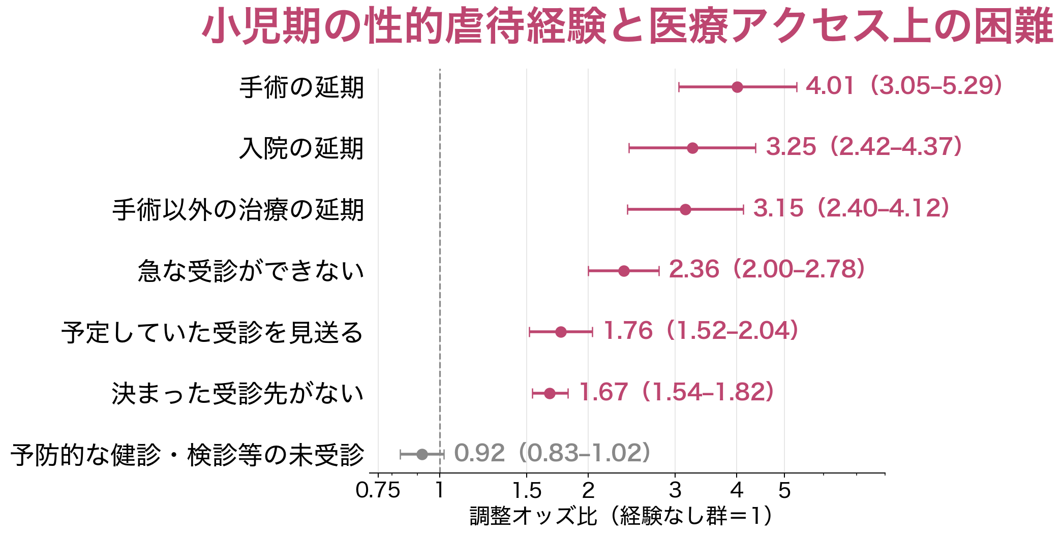
図1. 小児期の性的虐待経験と医療アクセス上の困難
<関連情報>
- https://www.tohoku.ac.jp/japanese/2026/08/press20260821-01-survivors.html
- https://link.springer.com/article/10.1186/s12939-026-02957-1
児童性的虐待被害者の医療アクセスにおける都市部と農村部の違い:全国調査 Urban and rural differences in healthcare access among survivors of child sexual abuse: a nationwide survey
Yousuke Imanishi,Masahide Koda,Maria Iorini,Ichiro Wada,Sinchul Jwa,Takahiro Tabuchi &Mai Uchida
International Journal for Equity in Health Published:24 July 2026
DOI:https://doi.org/10.1186/s12939-026-02957-1 Early provide
Abstract
Background
Child sexual abuse (CSA) is associated with poorer healthcare access in adulthood, but evidence remains limited on whether this association differs between urban and rural settings.
Methods
We analyzed data from the 2023 Japan COVID-19 and Society Internet Survey (JACSIS), including 27,699 adults aged 18–79 years. Participants reported CSA before age 18 using behavior-specific items and two direct screening questions. We assessed adult healthcare access barriers, including missed scheduled visits, inability to obtain unplanned care, postponed surgery, and absence of a usual source of care. We used inverse probability of treatment weighting and weighted logistic regression to estimate adjusted odds ratios (aORs) with 95% confidence intervals (CIs), and we tested CSA-by-urbanicity interaction terms.
Results
CSA prevalence was 9.3%. Adults with a history of CSA had higher odds of missed scheduled visits (aOR 1.76, 95% CI 1.52–2.04), inability to obtain unplanned care (aOR 2.36, 95% CI 2.00–2.78), hospitalization postponed (aOR 3.25, 95% CI 2.42–4.37), surgery postponed (aOR 4.01, 95% CI 3.05–5.29), and non-surgical treatment postponed (aOR 3.15, 95% CI 2.40–4.12). Preventive care not received did not differ significantly. CSA was also associated with higher odds of having no usual source of care (aOR 1.67, 95% CI 1.54–1.82). Urbanicity significantly modified associations for missed scheduled visits (urban: aOR 1.97, 95% CI 1.64–2.37; rural: aOR 1.44, 95% CI 1.12–1.85; p for interaction = 0.04) and preventive care not received (urban: aOR 1.01, 95% CI 0.88–1.15; rural: aOR 0.82, 95% CI 0.70–0.95; p for interaction = 0.04).
Conclusions
CSA survivors face substantial barriers to care. The stronger association with missed appointments in urban settings suggests that provider density alone does not ensure access. Trauma-informed care models may help reduce avoidance behaviors, particularly in high-volume urban practices.