2026-06-30 エディンバラ大学
<関連情報>
- https://www.ed.ac.uk/news/strong-torso-muscles-linked-to-lower-heart-attack-risk
- https://pubs.rsna.org/doi/10.1148/radiol.251821
SCOT-HEART試験における冠動脈CT血管造影による体組成、心筋梗塞、および死亡率の機械学習による多臓器解析 Machine Learning Multiorgan Analysis of Coronary CT Angiography Body Composition, Myocardial Infarction, and Mortality in the SCOT-HEART Trial
Alan Ranieri Guimaraes, PhD, Steven E. Williams, MBChB, PhD, Mark T. Macmillan, MBChB, PhD, Kayleigh Wood, MBChB, Chaoyang Wang, MBChB, Jonathan R. Weir-McCall, MBChB, PhD, Philip D. Adamson, MD, PhD, …, and Michelle C. Williams, MBChB, PhD
Radiology Published:Jun 30 2026
DOI:https://doi.org/10.1148/radiol.251821
Abstract
Background
Coronary CT angiography provides prognostic information in addition to coronary findings.
Purpose
To evaluate associations between machine learning–derived multiorgan body composition and 10-year outcomes in the SCOT-HEART (Scottish Computed Tomography of the Heart) trial.
Materials and Methods
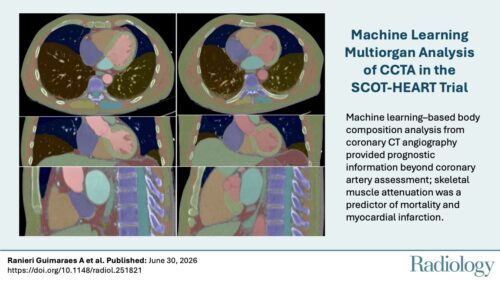
Wide field-of-view images of 1722 patients (recruited between November 2010 and September 2014) were retrospectively processed using the TotalSegmentator model. The volume and mean attenuation of segmented organs were calculated. Multivariable Cox proportional hazards models were constructed for all-cause mortality and myocardial infarction (MI), adjusted for age, sex, and scan length. Odds ratios or hazard ratios (HRs) and 95% CIs were calculated per 10-unit increase in attenuation or volume.
Results
Mortality and MI occurred in 133 (7.72%) and 106 (6.16%) of the 1722 patients, respectively (age, 57.5 years ± 9.5 [SD]; 55.7% male). Coronary artery disease was associated with greater lung attenuation (odds ratio, 1.04 [95% CI: 1.03, 1.06]; P < .001), lower liver attenuation (odds ratio, 0.87 [95% CI: 0.8, 0.95]; P = .034), and greater torso fat volume (odds ratio, 1.01 [95% CI: 1.01, 1.02]; P < .001) after multivariable adjustment. Increased skeletal muscle attenuation was associated with lower all-cause mortality (HR, 0.61 [95% CI: 0.47, 0.79]; P < .001) after multivariable adjustment. MI was associated with increased myocardial volume (HR, 1.09 [95% CI: 1.01, 1.16]; P = .018) and decreased rib (HR, 0.98 [95% CI: 0.96, 1.0]; P = .043) and skeletal muscle (HR, 0.69 [95% CI: 0.54, 0.87]; P = .002) attenuation after multivariable adjustment. However, when further adjusted for coronary calcium score, only skeletal muscle attenuation was associated with MI (HR, 0.72 [95% CI: 0.57, 0.91]; P = .007). Patients with skeletal muscle attenuation below the median had a higher risk of mortality (HR, 1.85 [95% CI: 1.30, 2.64]; P < .001) or experience MI (HR, 1.58 [95% CI: 1.07, 2.33]; P = .022).
Conclusion
Multiorgan body composition analysis using coronary CT angiography provided additional prognostic information, among which skeletal muscle attenuation was particularly important.