2026-08-12 カロリンスカ研究所(KI)
<関連情報>
- https://news.ki.se/blood-thinning-medication-linked-to-slower-cognitive-decline
- https://academic.oup.com/eurheartj/advance-article/doi/10.1093/eurheartj/ehag584/8758725
心房細動およびアルツハイマー病における経口抗凝固薬、認知機能、および臨床転帰:スウェーデン全国調査 Oral anticoagulants, cognition, and clinical outcomes in atrial fibrillation and Alzheimer’s disease: a Swedish nationwide study
Nanbo Zhu,Hong Xu,Sara Garcia-Ptacek,Sumonto Mitra,Maria Eriksdotter
European Heart Journal Published:12 August 2026
DOI:https://doi.org/10.1093/eurheartj/ehag584
Abstract
Background and Aims
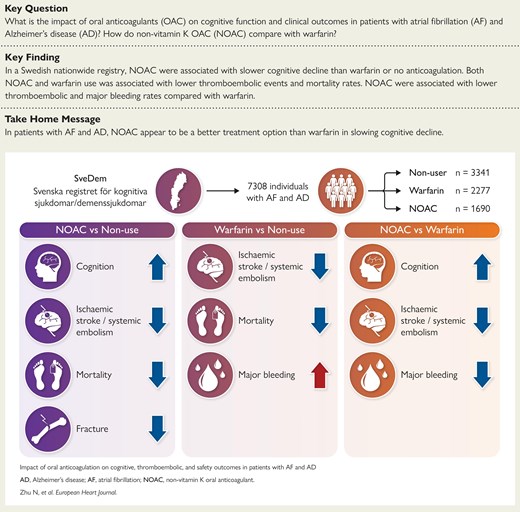
Use of non-vitamin K oral anticoagulants (NOACs) is associated with reduced dementia risk in patients with atrial fibrillation (AF), but their impact on cognitive function and clinical outcomes in AF patients with Alzheimer’s disease (AD) remains unclear.
Methods
Based on the Swedish Registry for Cognitive/Dementia Disorders, individuals with incident AD during May 2007–December 2020 and pre-existing AF were identified. Anticoagulant use at baseline was categorized as non-use, warfarin, or NOACs. Inverse probability of treatment weighting was employed to balance covariates. Mixed-effects models were used to assess the association between anticoagulant use and cognitive decline measured by the Mini-Mental State Examination (MMSE). Cox proportional hazards models were used to examine risks of all-cause mortality, ischaemic stroke/systemic embolism, major bleeding, and fracture.
Results
Among 7308 eligible individuals (3341 non-users, 2277 warfarin users, and 1690 NOAC users), NOAC users exhibited significantly slower cognitive decline compared to non-users (difference in MMSE scores β = 0.23 points/year, 95% confidence interval [CI] 0.11–0.36) and warfarin users (β = 0.21 points/year, 95% CI 0.10–0.33). Compared to non-use of anticoagulants, NOAC use was associated with significantly lower rates of mortality (hazard ratio [HR] 0.81; 95% CI 0.72–0.91), ischaemic stroke/systemic embolism (HR 0.66; 95% CI 0.53–0.82), and fracture (HR 0.79; 95% CI 0.64–0.97), without an increased rate of major bleeding (HR 1.05; 95% CI 0.84–1.32); in contrast, warfarin use was associated with significantly lower rates of mortality (HR 0.88; 95% CI 0.80–0.97) and ischaemic stroke/systemic embolism (HR 0.85; 95% CI 0.72–1.00), but a higher rate of major bleeding (HR 1.31; 95% CI 1.09–1.56). Compared to warfarin, NOAC use was associated with lower rates of ischaemic stroke/systemic embolism (HR 0.78; 95% CI 0.62–0.98) and major bleeding (HR 0.80; 95% CI 0.64–1.01), and non-significant reductions in mortality and fracture.
Conclusions
In patients with AF and AD, NOAC use was associated with modestly slower cognitive decline and more favourable effectiveness and safety profiles, compared to warfarin or no anticoagulation.