2026-08-12 中国科学院(CAS)
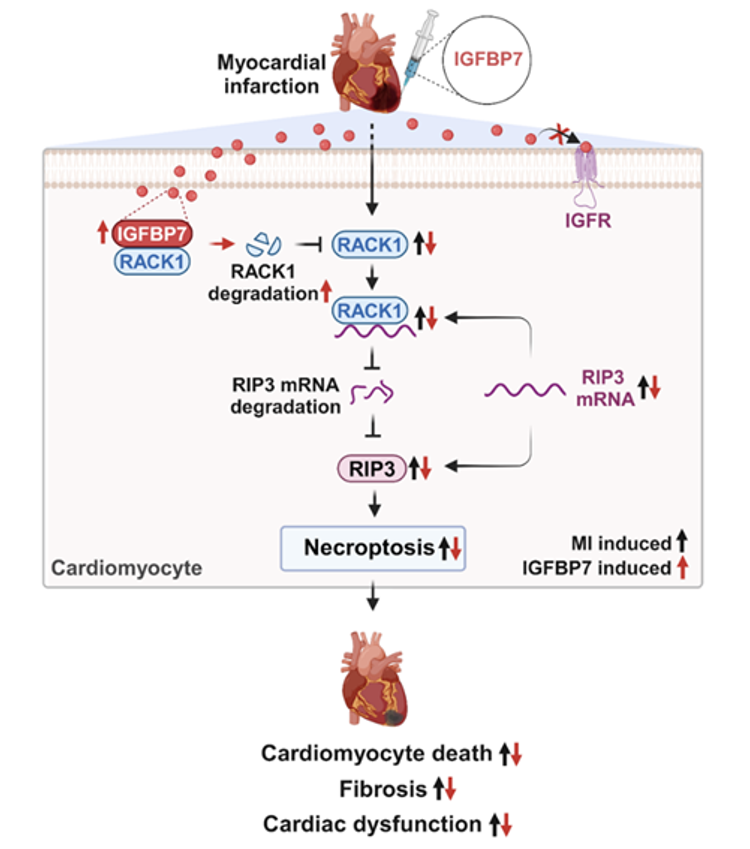
Schematic model of IGFBP7 suppressing cardiomyocyte necroptosis and promoting cardiac repair post-MI. (Image by Prof. YANG’s group)
<関連情報>
- https://english.cas.cn/newsroom/research-news/202608/t20260812_1187826.shtml
- https://www.sciengine.com/SCLS/doi/10.1007/s11427-026-3417-2
IGFBP7は心筋細胞のアポトーシスを抑制することにより、梗塞を起こした心臓の治癒を促進する IGFBP7 promotes healing of infarcted hearts via suppression of cardiomyocyte necroptosis
Qiang Li, Ping Shang, Huitong Shan, Minxia Ke, Jiliang Tan, Senle Rao, Yun Jiang, Junming Tang, Huangtian Yang
Science China Life Sciences Available Online: Aug 7, 2026
DOI:https://doi.org/10.1007/s11427-026-3417-2
Abstract
Necroptosis is crucially involved in cardiomyocyte death during myocardial infarction (MI). However, its regulatory mechanisms have not been fully clarified. Insulin-like growth factor–binding protein 7 (IGFBP7) has been showed to contribute to hypertrophy, whereas its functions in MI hearts and MI-induced cardiomyocyte death are unclear. Here, we aimed to determine the role of IGFBP7 in MI-induced cardiomyocyte necroptosis and the mechanisms involved. IGFBP7 expression was elevated in mouse infarcted hearts and reached a peak at 7 days post-MI. The immunofluorescence staining confirmed its enhancement in the cardiomyocytes of infarcted hearts. Cardiac-specific knockout of IGFBP7 (Igfbp7CM-/-) aggravated MI-induced cardiomyocyte necroptosis, functional worsening, and scar formation, whereas intramyocardial injection of human recombinant IGFBP7 (hIGFBP7) ameliorated the injury in an IGF-independent way. Further, hIGFBP7 suppressed oxygen glucose deprivation (OGD)-induced necroptosis in adult mouse cardiomyocytes (AMCMs) and human embryonic stem cell-derived cardiomyocytes. Mechanistically, MI/OGD-induced increases of receptor for activated C kinase 1 (RACK1) and receptor-interacting protein 3 (RIP3) were downregulated by hIGFBP7 but elevated by Igfbp7CM-/-, whereas the protective effects of hIGFBP7 in MI hearts of Rip3 knockout (Rip3-/-) mice and OGD-injured Rip3-/- AMCMs remained unchanged. RNA pull-down and RNA immunoprecipitation proved the binding of RACK1 to Rip3 mRNA, leading to the prolonged half-life of Rip3 mRNA. Further analysis showed that only full-length IGFBP7 but not truncated IGFBP7 interacted with RACK1, resulting in downregulation of RACK1 protein and Rip3 mRNA, subsequently suppression of necroptosis in injured cardiomyocytes. Our data demonstrate that IGFBP7 protects hearts against MI injury by reducing cardiomyocyte death via targeting necroptosis. Its beneficial effects are at least mediated by RACK1 downregulation through binding to IGFBP7 and promotion of its degradation, subsequently destabilizing Rip3 mRNA. These findings uncover reparative effects of IGFBP7 in infarcted hearts and provide new mechanistic insights how Rip3 mRNA is downregulated by a cytokine targeting MI-induced cardiomyocyte necroptosis.