2026-06-30 エディンバラ大学
<関連情報>
- https://www.ed.ac.uk/news/rare-ageing-disorder-links-biological-clock-to-disease
- https://www.nature.com/articles/s41588-026-02633-8
早老症候群はDNAの過剰メチル化と加齢関連病理を結びつける A progeria syndrome links DNA hypermethylation to age-related pathology
Dan Sarni,Gráinne Neary,Paula L. Carroll,Chris S. Vink,Caroline V. Billard,Tomoya Isobe,Xiong Weng,Jordan R. Portman,Daniel L. McCartney,Patricia Heyn,Rob J. van ‘t Hof,Linda R. Morrison,Carol-Anne Martin,Colin Stok,Margaret E. Harley,Andrea Leitch,Maarten van den Ancker,Nic Robertson,Laura Kitto,Richard Clark,Michael Rennie,Anna Popravko,Jessica J. McClure,David A. Parry,… Andrew P. Jackson
Nature Genetics Published:12 June 2026
DOI:https://doi.org/10.1038/s41588-026-02633-8
Abstract
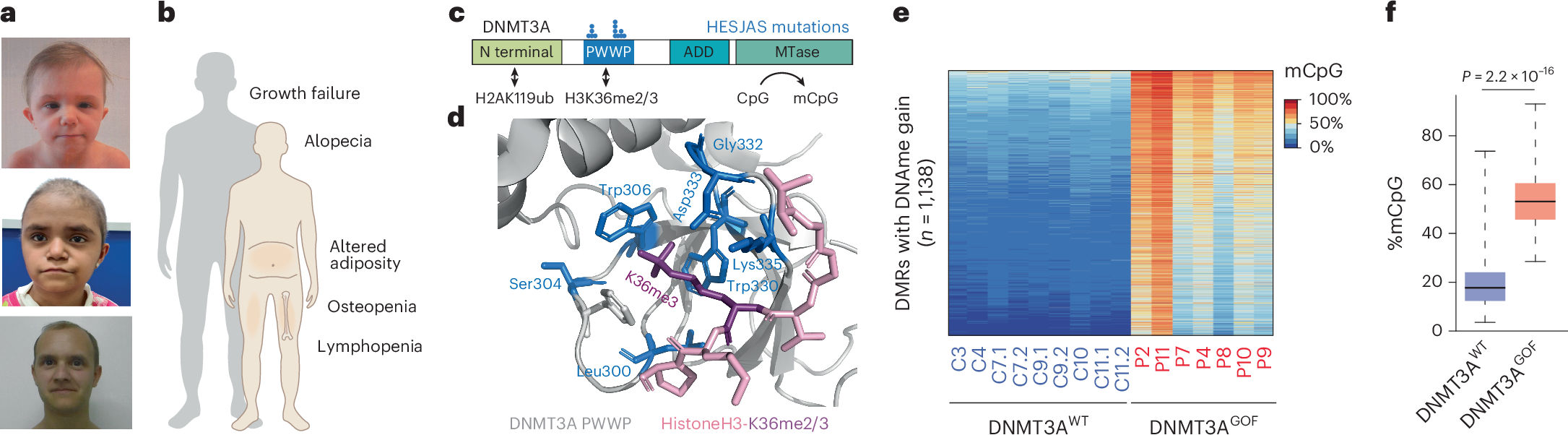
Declining tissue function and regenerative capacity underlie many chronic diseases. Experimentally establishing the mechanistic basis for such tissue aging presents substantial challenges, given decades-long timescales and multifactorial origins. Epigenetic alterations have been proposed to have a key etiological role, but whether they are correlative or causal remains a key unanswered question, as does their contribution to specific age-related pathologies. Here we describe an epigenetically driven accelerated aging syndrome. We demonstrate that DNMT3A gain-of-function mutations in Heyn–Sproul–Jackson syndrome recapitulate age-related gains in DNA methylation (DNAme), cause multilineage stem cell dysfunction, and phenocopy aspects of aging in humans and mice. We also show that region-specific DNA hypermethylation at lineage-specific genes can explain reduced stem cell output and lineage skewing. Hence, starting from a Mendelian disorder, we implicate DNAme-mediated stem cell dysfunction in the etiology of medically important age-related hematological, bone and metabolic pathologies, which might be targetable by future therapies.