2026-06-26 バーミンガム大学
<関連情報>
- https://www.birmingham.ac.uk/news/2026/ai-clinical-support-tool-improved-clinician-decisions-in-real-world-primary-care-trial
- https://www.nature.com/articles/s41591-026-04503-6
プライマリケアにおける生成型AIを活用した臨床意思決定支援システム:実用的クラスターランダム化試験 Generative AI-enabled clinical decision support system in primary care: a pragmatic, cluster-randomized trial
Ambrose Agweyu,Paul Mwaniki,Vaishnavi Menon,Robert Korom,Lynda Isaaka,Conrad Wanyama,Jaspret Gill,Sarah Kiptinness,Najib Adan,Mira Emmanuel-Fabula,Richard D. Riley,Lucinda Archer,Alastair K. Denniston,Xiaoxuan Liu & Bilal A. Mateen
Nature Medicine Published:26 June 2026
DOI:https://doi.org/10.1038/s41591-026-04503-6
Abstract
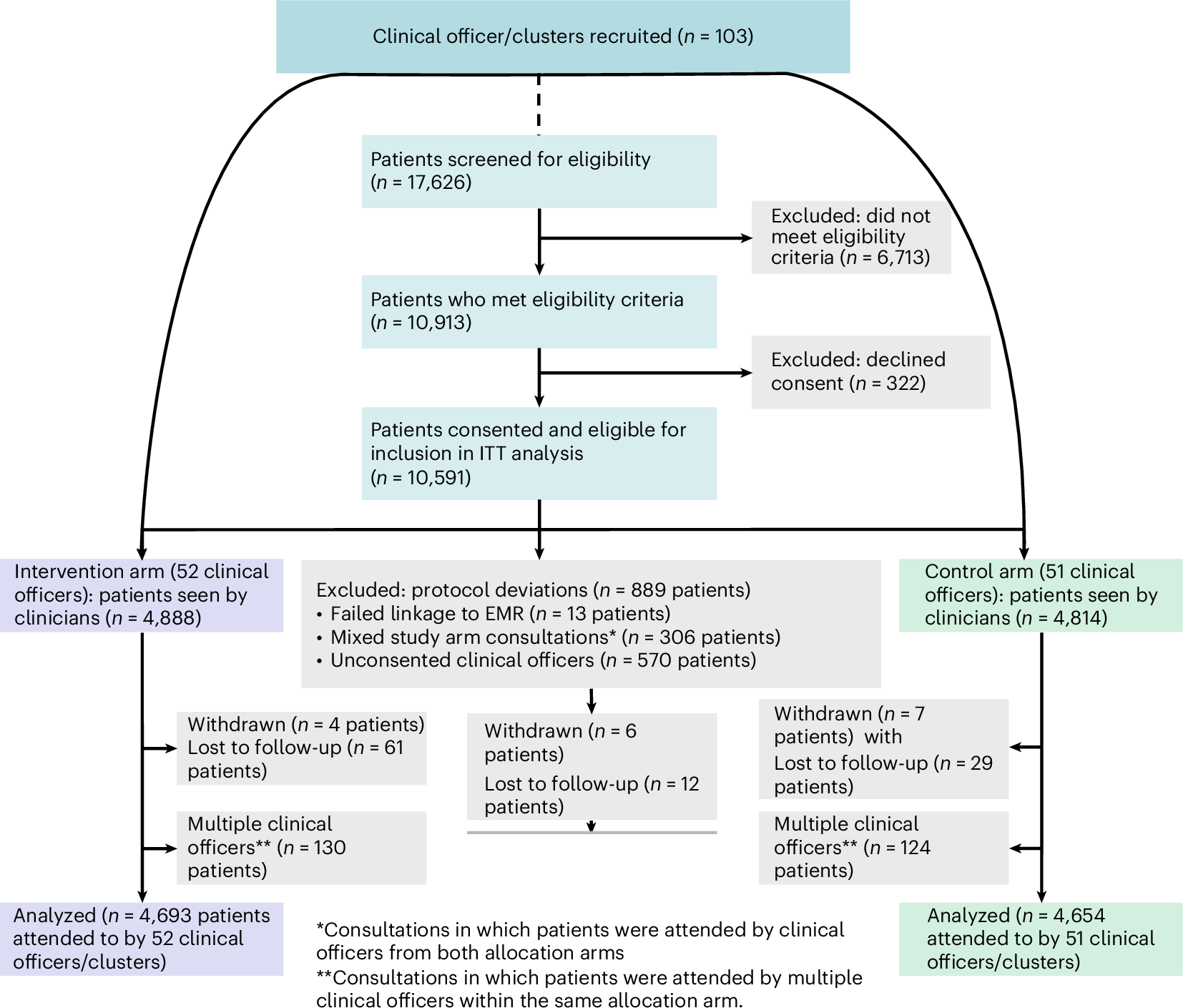
Rigorous evidence on the performance of large language models (LLMs) in real-world, low-resource clinical settings remains limited. Here we conducted a pragmatic, cluster-randomized trial in 16 primary care facilities in Kenya. Clinical officers were randomized to use the electronic medical record with or without LLM assistance. The primary outcome was an expert-adjudicated composite of treatment failure events experienced within 14 days of enrollment. Between 22 April and 16 July 2025, 9,691 patients were enrolled, overseen by 103 clinical officers (52 in the LLM-assisted arm and 51 in the control arm). Treatment failure occurred in 102/4,693 patients (2.2%) in the intervention arm and 94/4,654 (2.0%) in the control arm (adjusted odds ratio 0.77, 95% confidence interval 0.55 to 1.08, P = 0.13). The primary outcome did not differ significantly between groups. No serious adverse events were judged related to the intervention, and independent review of the adverse events did not identify a safety signal. In this trial, LLM assistance was safe but did not reduce treatment failure within 14 days and any benefit, if present, is probably modest.