2026-06-30 スウォンジー大学
<関連情報>
- https://www.swansea.ac.uk/press-office/news-events/news/2026/06/not-all-green-space-is-equal-new-framework-highlights-overlooked-ecological-factors-in-nature-prescribing.php
- https://iopscience.iop.org/article/10.1088/1748-9326/ae803f
生態系を介した自然に基づくウェルビーイングのためのワンヘルス持続可能性フレームワーク A one health sustainability framework for ecologically mediated nature-based wellbeing
Konstans Wells, Menna Brown, Carmen Jochem and Brian Garro
Environmental Research Letters Published: 30 June 2026
DOI:10.1088/1748-9326/ae803f
Abstract
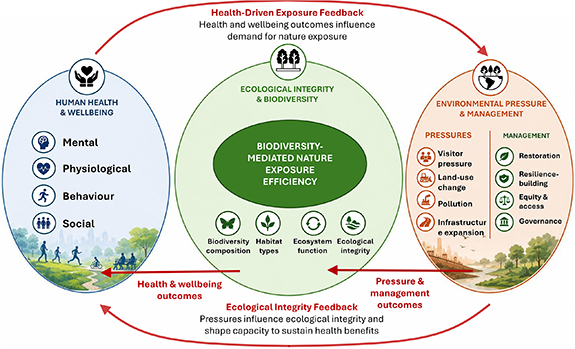
Human health benefits associated with nature exposure are increasingly recognised in public health and environmental policy. However, most evidence linking nature and wellbeing relies on broad anthropogenic exposure proxies, including greenness indices, land-cover categories, and self-reported visit frequency, rather than ecological measures capturing biodiversity, habitat condition, or ecosystem functioning. Consequently, the ecological conditions that mediate health benefits, their exposure–response relationships, and the long-term sustainability of nature-based wellbeing interventions remain poorly understood. Here we examine how current research integrates human health, ecological integrity, and sustainability dimensions within nature-based wellbeing research. A targeted evidence synthesis confirms that most research is conducted in urban or human-modified environments and relies predominantly on coarse spatial proxies or categorical exposure contrasts, with limited incorporation of ecological quality, biodiversity, or environmental pressures. Critically, ecological costs and feedbacks associated with nature use, including habitat disturbance, visitor pressure, and infrastructure expansion, are rarely accounted for in assessments of health outcomes. We propose a one health sustainability framework that conceptualises nature-based wellbeing as an emergent property governed by ecological integrity, biodiversity-mediated pathways, environmental pressures, and long-term sustainability feedbacks. Extending one health beyond its traditional focus on zoonotic disease, this framework links human wellbeing outcomes to ecological condition and sustainability constraints, enabling assessment of exposure efficiency and the capacity of ecosystems to sustain health benefits under increasing demand. Embedding ecological integrity and sustainability dynamics within nature-based wellbeing research provides a basis for developing integrated indicators that can evaluate not only whether nature exposure benefits health, but also under what ecological conditions such benefits remain equitable and durable over time.