2026-08-21 東北大学
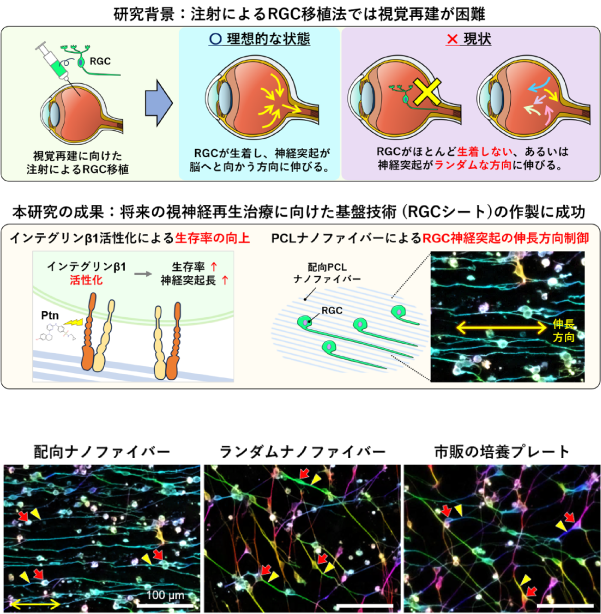
図1. 配向PCLナノファイバーによるiPS細胞由来RGCの神経突起の伸長方向制御 配向したPCLナノファイバー、ランダムな方向性のPCLナノファイバー、および市販の培養プレート上で培養したiPS細胞由来RGCの様子。細胞足場であるPCLナノファイバーの方向性によってRGCの神経突起の伸長方向を制御可能であることが実証された。
<関連情報>
- https://www.tohoku.ac.jp/japanese/2026/08/press20260821-02-sheets.html
- https://pubs.acs.org/abseba/article/doi/10.1021/acsbiomaterials.6c00694/5250182/Construction-of-Highly-Viable-Excitable-Aligned
インテグリンβ1を介した接着経路を標的とした、ポリ-ε-カプロラクトンナノファイバー上に高生存性、高興奮性、高配向性を有するヒト誘導多能性幹細胞由来網膜神経節細胞シートの構築 Construction of Highly Viable, Excitable, Aligned Human Induced Pluripotent Stem Cell-Derived Retinal Ganglion Cell Sheets on Poly-ε-caprolactone Nanofibers by Targeting Integrin β1-Mediated Adhesion Pathways
Seiya Kanno;Masayuki Yamashita;Kota Sato;Toru Nakazawa
ACS Biomaterials Science & Engineering Published:August 07, 2026
DOI:https://doi.org/10.1021/acsbiomaterials.6c00694
Abstract
Transplantation of induced pluripotent stem cell-derived retinal ganglion cells (RGCs) is a promising strategy for optic nerve regeneration and vision restoration in glaucoma. However, injections of conventional single-cell suspensions have low engraftment rates, hindering the formation of the complex neural circuits essential for functional recovery. This study addresses this challenge by investigating an in vitro biomimetic tissue engineering approach designed for future translational objectives, such as RGC transplantation therapy. We systematically evaluated coating materials and culture supplements critical for the survival and morphological development of RGCs on biocompatible, aligned poly-ε-caprolactone (PCL) nanofiber membranes. Notably, we identified the xeno-free extracellular matrix (ECM) conditions that promote RGC neurite extension at levels comparable to animal-derived ECM, thereby overcoming a major barrier to clinical translation of this technique. Furthermore, while RGCs typically have compromised viability and limited outgrowth on nanofibers, enhancing cell-scaffold adhesion signaling via the integrin β1/focal adhesion kinase pathway significantly improved both survival and neurite development. Crucially, RGCs on aligned PCL nanofibers extended neurites along the longitudinal axes of the nanofibers, with both somata and neurites exhibiting functional calcium responses to depolarization. These findings represent a significant advancement in biomimetic in vitro tissue engineering aimed at recapitulating retinal neurite orientation, providing a scalable platform for future nanofiber-based neural regeneration therapies, with the ultimate goal of clinical applicability.