2026-08-20 ワシントン州立大学(WSU)
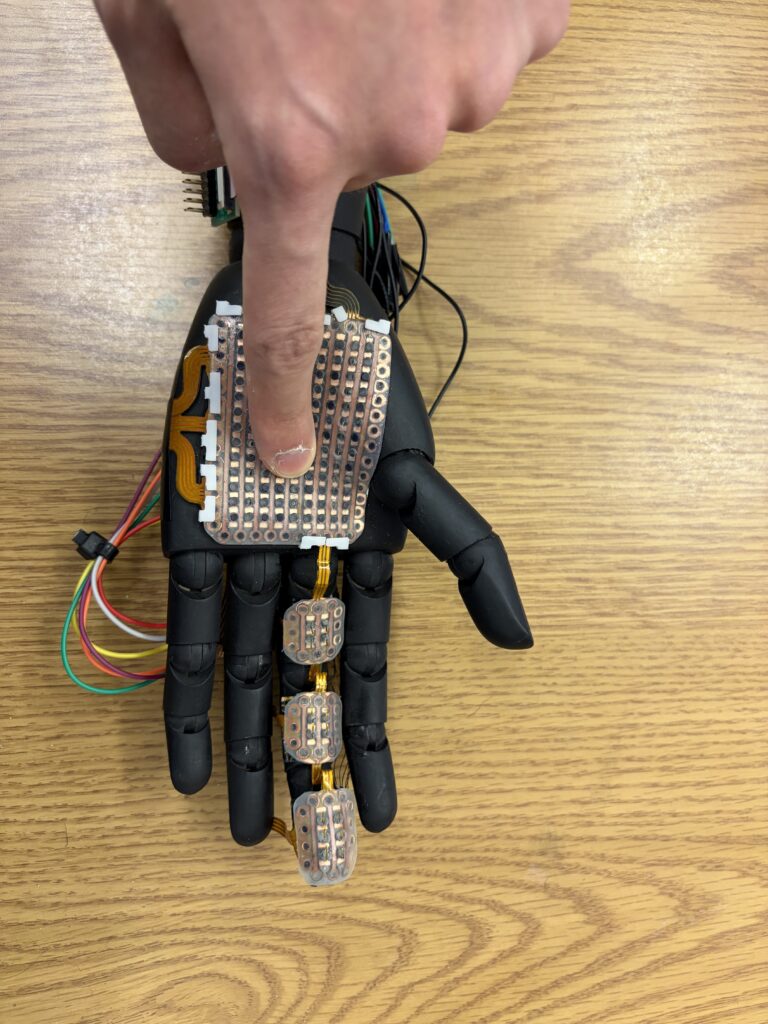
A robotic hand fitted with 3D-printed sensor module developed by the research team. (Photo by Sravanthi Yalamanchili/WSU)
<関連情報>
- https://news.wsu.edu/press-release/2026/08/20/researchers-develop-electronic-skin-for-prosthetics-to-sense-temperature-and-pressure/
- https://www.cell.com/cell-reports-physical-science/fulltext/S2666-3864%2826%2900364-4
義肢における質感および材質識別のための、形状認識型でカスタマイズ可能なマルチモーダルセンシングシステム A geometry-aware and customizable multimodal sensing system for texture and material identification in prosthetics
Hongyi Shen ∙ Nikolai Bogdev ∙ Yusen Zhang ∙ Shanshan Yao ∙ Prashanta Dutta ∙ Kaiyan Qiu
Cell Reports Physical Science Published: July 27, 2026
DOI:https://doi.org/10.1016/j.xcrp.2026.103458
Highlights
- “Scan-model-print” workflow enables seamless coverage over free-form regions
- Modular, LEGO-like snap-fit sensing modules that support on-demand installation
- Interlaced, decoupled pressure and temperature matrices increase sensing density
- Neural network-based calibration and denoising in high-density sensing modules
Summary
The restoration of natural somatosensation remains largely absent in upper-limb prostheses. Current electronic skins are still limited by coarse resolution, planar form factors, and high fabrication cost. Here, we present a geometry-aware and customizable multimodal sensing system for prostheses that functions as a sensing component for mimicking human skin. The system integrates high-resolution and high-rate pressure and temperature mapping in conformal, free-form modules. A “scan-model-print” workflow converts a patient’s prosthesis topography into 3D sensor curvature for seamless surface conformity. Self-aligning snap-fit interconnects enable on-demand reconfiguration, while interlaced pressure and temperature matrices maximize spatial utilization. Compared with commercial glove sensors, the system achieves ∼10-fold finer spatial resolution for pressure and temperature. A multihead neural network performs real-time calibration and denoising, thereby reducing per-pixel error and improving signal fidelity. The system enables texture and material identification and provides a sensing platform toward personalized prostheses with integrated sensing and haptic feedback.