20026-08-28 名古屋大学
<関連情報>
- https://www.nagoya-u.ac.jp/researchinfo/result/2026/05/post-1003.html
- https://pubs.acs.org/doi/10.1021/acsinfecdis.6c00032
ヘム獲得経路を標的としたトロイの木馬戦略による、超病原性アシネトバクター・バウマニの光線力学的失活 Photodynamic Inactivation of Hypervirulent Acinetobacter baumannii via a Trojan Horse Strategy Targeting Heme Acquisition Pathway
Viet Q. Nguyen,Hiroshi Sugimoto,and Osami Shoji
ACS Infectious Diseases Published: May 25, 2026
DOI:https://doi.org/10.1021/acsinfecdis.6c00032
Abstract
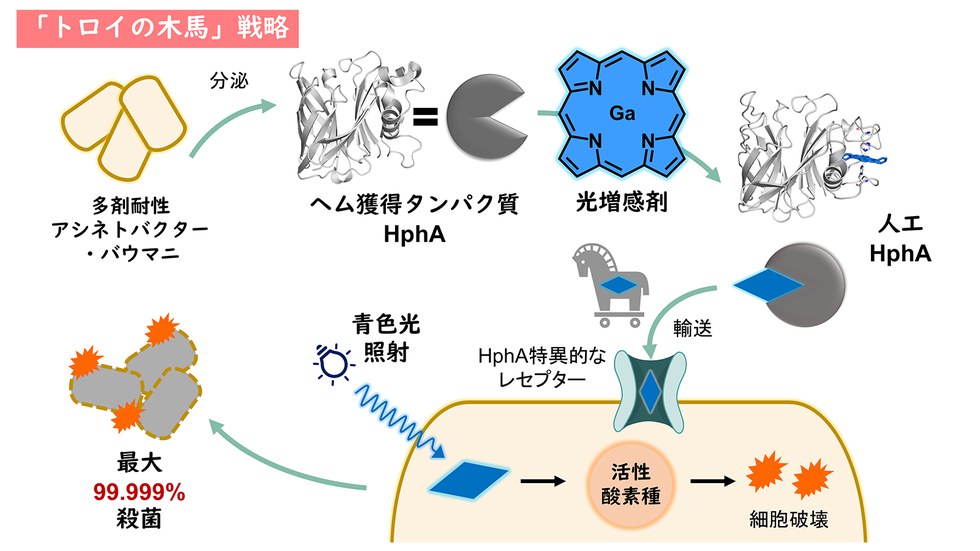
Multidrug-resistant (MDR) pathogens pose a major threat to global health, and novel therapeutics are urgently needed to combat the rapid evolution of antimicrobial resistance. Acinetobacter baumannii is one of the notorious MDR pathogens associated with severe hospital- and community-acquired infections worldwide. Herein, we demonstrate a “Trojan horse” strategy that exploits the recently discovered bacterial heme acquisition protein HphA to selectively sterilize A. baumannii. We found that the hemophore HphA, secreted by virulent A. baumannii strains, can accommodate several synthetic metal complexes such as 5,15-diphenylporphyrin and phthalocyanine that are structurally distinct from heme. Given that the crystal structure of HphA bound to synthetic metal complexes closely resembles that of the heme-bound form, we employed HphA as a carrier for gallium photosensitizers to photoinactivate the hypervirulent and MDR A. baumannii AB5075 strain. Upon photoirradiation, HphA incorporating gallium tetraphenylporphyrin and gallium 5,15-diphenylporphyrin (Ga-DPP) achieved efficient bacterial elimination, while a bromo-substituted Ga-DPP derivative exhibited superior sterilization efficiency, achieving 99.999% bacterial killing. These findings demonstrate that the HphA-mediated heme uptake pathway of A. baumannii can be harnessed to selectively and efficiently deliver photosensitizers, enabling potent photosterilization of antibiotic-resistant A. baumannii.