2026-05-05 沖縄科学技術大学院大学
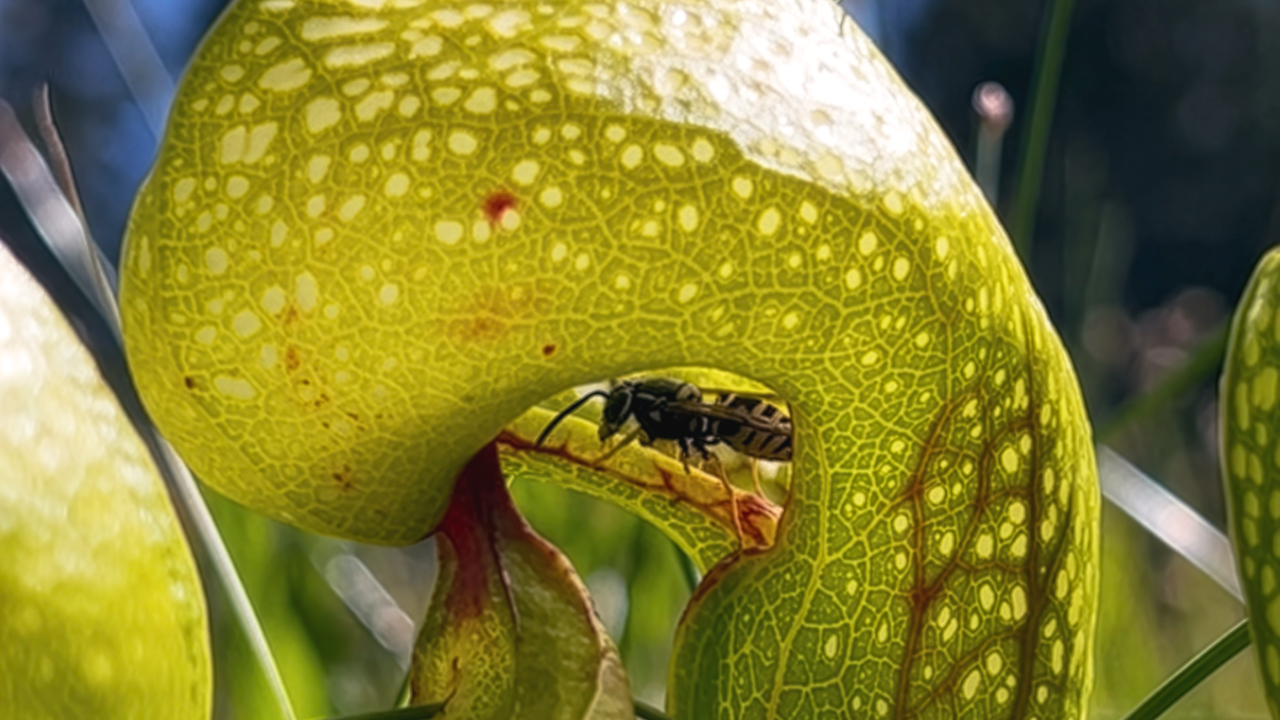
© Asa Conover
<関連情報>
- https://www.oist.jp/ja/news-center/news/2026/5/5/carnivorous-plants-and-wasps-blur-line-between-friend-and-food
- https://esajournals.onlinelibrary.wiley.com/doi/10.1002/ecy.70395
偽装された共生?食虫植物ウツボカズラから昆虫の獲物への栄養素の移動を示す同位体証拠 Mutualism in disguise? Isotopic evidence for nutrient transfer from a carnivorous pitcher plant to its insect prey
David W. Armitage, Asa E. Conover, Katharine M. Saunders
Ecology Published: 04 May 2026
DOI:https://doi.org/10.1002/ecy.70395
Abstract
Consumer–resource interactions can shift from exploitative to mutualistic when reciprocal benefits such as nutrient exchange offset the costs of damage or mortality, though these benefits are often difficult to detect. Carnivorous pitcher plants are typically viewed as exploiters of arthropod prey, yet most visitors escape capture and may gain access to concentrated, nutrient-rich rewards. This raises the possibility that pitcher plants and their arthropod visitors engage in an indirect mutualism in which both insects and plants incur costs but reap net nutritive benefits. However, evidence that potential prey species derive measurable nutritional benefits from pitcher plants is lacking. To address this knowledge gap, we measured nitrogen isotopic enrichment in vespulid wasps residing in dense stands of the naturally 15N-enriched pitcher plant Darlingtonia californica relative to wasps from adjacent forest patches. Wasps occupying pitcher fens exhibited elevated δ15N values, indicating assimilation of 15N-enriched nitrogen originating from Darlingtonia—either directly through nectar consumption or indirectly via pitcher-enriched arthropod prey. These findings are consistent with reciprocal nutrient exchange between carnivorous plants and local insect populations.