2026-05-01 沖縄科学技術大学院大学
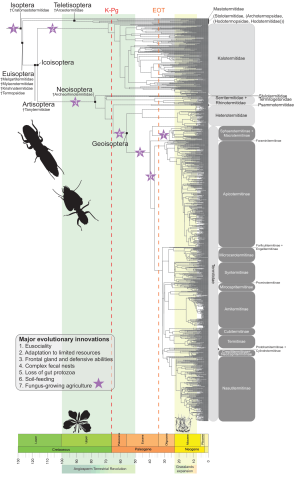
研究のデータに基づいて再構築されたシロアリの進化。重要な形質の発達(紫色の星印)とともに、白亜紀末大量絶滅および始新世-漸新世絶滅が赤い点線で示されている。© Hellemans 他(2026年)
<関連情報>
- https://www.oist.jp/ja/news-center/news/2026/5/1/innovation-and-ecological-collapse-gave-rise-tropics-most-important-decomposers
- https://www.cell.com/current-biology/abstract/S0960-9822(26)00443-4
シロアリは2度の多様化の波を経て、熱帯地域における主要な分解者となった Termites became the dominant decomposers of the tropics after two diversification pulses
Simon Hellemans ∙ Menglin Wang ∙ Corentin Jouault ∙ … ∙ Eliana M. Cancello ∙ Rudolf H. Scheffrahn ∙ Thomas Bourguignon
Current Biology Published:April 30, 2026
DOI:https://doi.org/10.1016/j.cub.2026.04.008
Highlights
- Termites diversified in two major pulses
- The first pulse involved Kalotermitidae and Neoisoptera during the Late Cretaceous
- The second pulse involved multiple Termitidae lineages in the Oligocene and Miocene
- The diversification of termites followed climate-driven biome turnover
Summary
In modern tropical ecosystems, termites are the dominant non-microbial decomposers. However, the timing and drivers of their rise remain unclear. To investigate termite diversification over the past 130 million years, we reconstructed the most comprehensive time-calibrated phylogeny to date by sampling more than 1,300 species (∼47% of described diversity). Our diversification analyses revealed two major pulses. The first occurred in the Late Cretaceous period and marked the initial radiation of Kalotermitidae, followed by the early radiation of Neoisoptera as the diversification of Kalotermitidae slowed down. The second, stronger pulse followed the Eocene-Oligocene transition and extended into the Miocene. This phase coincided with global cooling, rainforest contraction, and savanna expansion. It involved repeated diversification within the Termitidae family and was accompanied by extensive transoceanic dispersal, which led to the global spread of Neoisoptera and the formation of modern tropical termite communities. Together, our results suggest that climate-driven biome turnover and global dispersal, rather than plant innovation, underpinned the rise of termites as dominant tropical decomposers.