2026-05-21 京都大学
◆研究では、脚や顎の詳細な形態観察に加え、遺伝子解析による系統解析を実施した。その結果、クラゲエボシはクラゲに特化した系統ではなく、カニや魚類に付着するエボシガイ類に近縁であることが判明した。また、野外観察と飼育実験から、クラゲエボシが宿主であるクラゲの触手を直接食べていることを発見した。多くのエボシガイ類は付着基盤を利用するだけで宿主そのものを摂食しないため、このような寄生的な食性は極めて珍しい。
◆研究成果は、エボシガイ類がどのように宿主利用を進化させてきたかを示す重要な知見であり、海洋生物における共生・寄生関係の進化過程の理解を深めるものとなった。
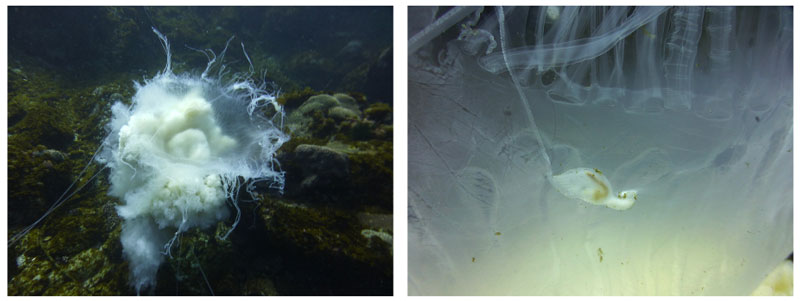
左:ユウレイクラゲ(大きさは30cmほど)、右:宿主クラゲの触手を捕食するクラゲエボシ(大きさは2cmほど)。撮影:平林勲。
<関連情報>
- https://www.kyoto-u.ac.jp/ja/research-news/2026-05-21
- https://brill.com/view/journals/cr/99/5/article-p629_8.xml
クラゲに寄生するエボシガイ「クラゲエボシ」の系統と、宿主クラゲの捕食 Phylogenetic position of the jellyfish-parasitising stalked barnacle Alepas pacifica (Cirripedia, Lepadoidea, Heteralepadidae) and its feeding on the host’s tentacles
Luna Yamamori,Isao Hirabayashi,Hiromi K. Watanabe,…
Crustaceana Published:12 May 2026
DOI:https://doi.org/10.1163/15685403-bja10528
Abstract
Stalked barnacles are sessile crustaceans that attach to various marine organisms and drifting substrates. Among them, Alepas spp. (Cirripedia: Scalpellomorpha: Heteralepadidae) exhibit a highly specialised lifestyle by attaching to the marginal areas of the umbrella of large jellyfish species such as Cyanea nozakii and Diplulmaris malayensis, drifting along with their hosts. In this study, we observed the ecology of Alepas pacifica collected from Cyanea nozakii off the coast of Kushimoto and Shirahama, Wakayama Prefecture, Japan, and conducted molecular phylogenetic analyses. Field observations revealed that A. pacifica individuals were directly feeding on the host’s tentacles, suggesting that they utilise host tissues as a nutritional resource. Molecular phylogenetic analyses further demonstrated that Alepas is included in the genus Conchoderma, which commonly attach to nektonic organisms such as sea snakes and fishes. Although Alepas has traditionally been classified within the Lepadidae based on morphological traits, such as the presence of filamentary appendages at the bases of multiple cirri, its phylogenetic position within the family has remained unclear. This uncertainty is likely due to adaptations to life on gelatinous zooplankton hosts, including the reduction of calcareous plates and increased body transparency. Our findings indicate that Alepas represents a lineage of barnacles that shifted its ecological association from commensalism with vertebrates to parasitism on planktonic jellyfish.