2026-08-07 東京慈恵会医科大学
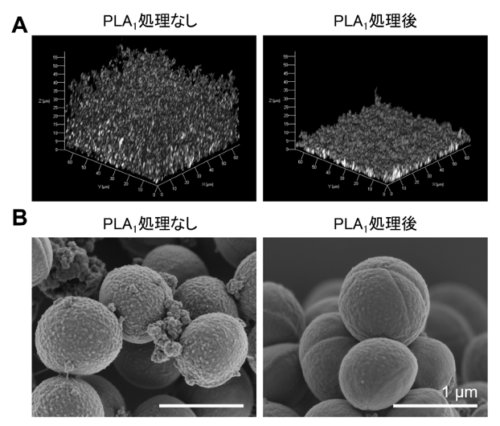
図1.PLA1によるMRSAバイオフィルムの破壊. A.共焦点レーザー顕微鏡(CLSM)像.B.FE-SEM像.PLA1処理後にバイオフィルムが菲薄化し、MRSAの細胞表層の微粒子が消失している。
<関連情報>
- https://www.jikei.ac.jp/press/detail/?id=49385
- https://www.jikei.ac.jp/wp-content/uploads/2026/08/【慈恵大学】プレスリリース_世界初、難治性感染症の原因となる「分子の接着剤」を発見_20260807配信.pdf
- https://www.nature.com/articles/s41522-026-01105-5
リジルホスファチジルグリセロールは、バイオフィルムマトリックス成分として黄色ブドウ球菌の細胞間接触とバイオフィルム形成を促進する Lysyl-phosphatidylglycerol promotes cell-to-cell contact and biofilm formation of Staphylococcus aureus as a biofilm matrix component
Shinya Sugimoto,Keiichiro Hara,Yoshitaka Taketomi,Yuki Nagasaki,Chikara Sato,Makoto Murakami & Yuki Kinjo
npj Biofilms and Microbiomes Published:20 July 2026
DOI:https://doi.org/10.1038/s41522-026-01105-5
Abstract
Staphylococcus aureus biofilms contribute significantly to persistent infections and antibiotic resistance, supported by a complex extracellular matrix. While their proteins, polysaccharides, and extracellular DNA have been well studied, the role of phospholipids in biofilm architecture remains underexplored. Here, we identify extracellular phospholipids within the biofilm matrix, particularly lysyl-phosphatidylglycerol (Lys-PG), as critical structural elements in S. aureus biofilms. Bacterial phospholipase A1 (PLA1), which hydrolyzes phospholipid acyl ester bonds, effectively dispersed pre-formed biofilms and prevented biofilm formation by hydrolyzing extracellular phospholipids, without affecting bacterial growth or exhibiting cytotoxicity. Microscopic analyses revealed that PLA1 disrupts membranous nanostructures integral to biofilm stability. Lipidomic analysis demonstrated an enrichment of Lys-PG with specific fatty acid species within the biofilm matrix and confirmed their hydrolysis by PLA1. Mechanistically, Lys-PG promotes bacterial aggregation by acting as a molecular glue through electrostatic and hydrophobic interactions. Deletion of mprF, responsible for Lys-PG synthesis, markedly impaired biofilm formation. These findings uncover a previously unrecognized structural role of extracellular phospholipids in biofilm architecture and suggest that targeting Lys-PG and its biosynthetic pathway represents a promising strategy for biofilm control.