2026-08-06 東京科学大学
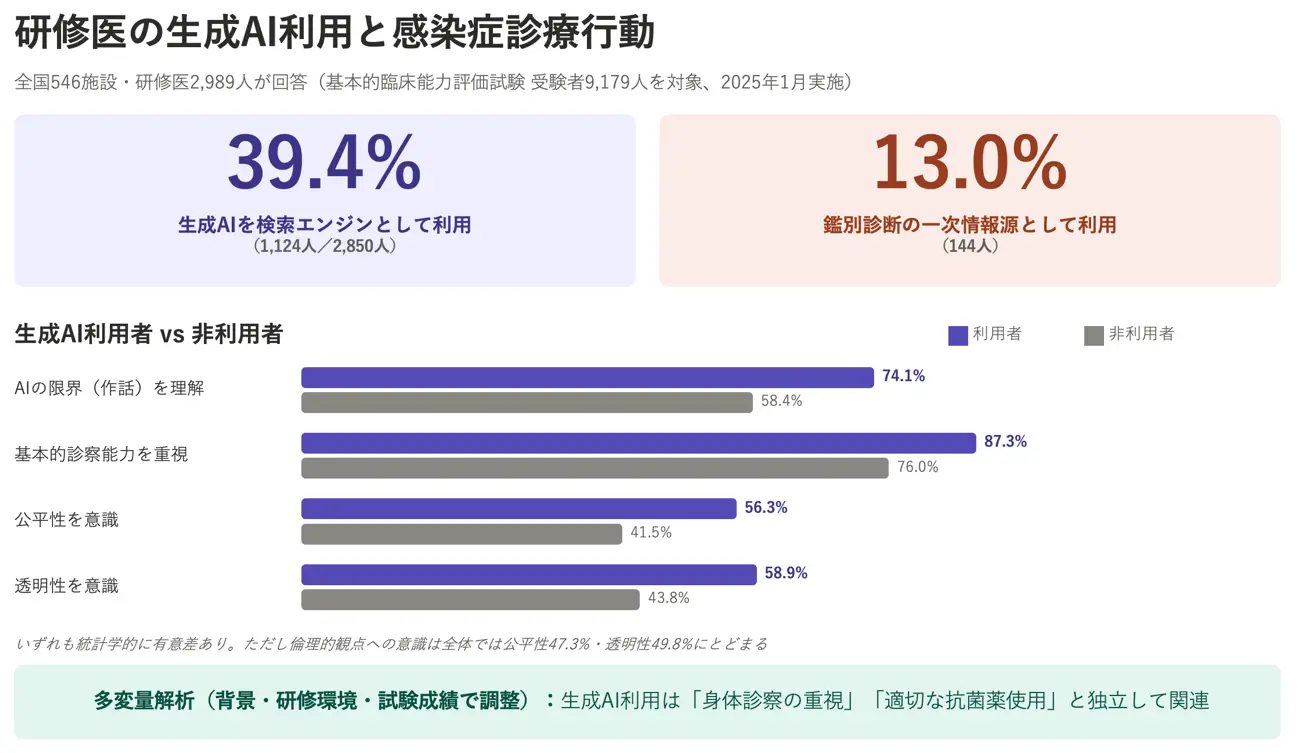
図1. 研修医の生成AI利用と感染症診療行動における関連調査結果。
全国546施設・研修医2,989人が回答(基本的臨床能力評価試験 受験者9,179人を対象、2025年1月実施)
<関連情報>
研修医における検索エンジンとしての生成型AI利用の現状:横断研究 Current Landscape of Generative AI Use as a Search Engine Among Resident Physicians: Cross-Sectional Study
Toshiki Miwa; Koh Okamoto; Yuji Nishizaki; Yasuharu Tokuda
JMIR AI Published:17.Jul.2026
DOI:https://preprints.jmir.org/preprint/89750
Abstract
Background:Acquiring generative AI (GenAI) literacy and avoiding knowledge collapse and inadequate skill development are critical for resident physicians in the GenAI era, who are highly susceptible to its influence, including those who are current nonusers.
Objective:This study examined the degree of GenAI use as a search engine in clinical practice among resident physicians and compared differences in AI literacy and bedside behaviors in the management of infectious diseases between GenAI users and nonusers.
Methods:This cross-sectional study was conducted through an original questionnaire survey administered in January 2025 to participants of the General Medicine In-Training Examination (GM-ITE), a nationwide computer-based test for postgraduate year 1 and year 2 resident physicians in Japan. The survey items covered the degree of GenAI use, GenAI literacy, and perceived bedside behaviors. In addition to the GM-ITE score, we collected data on demographics and survey responses. Statistical analysis was performed to compare attitudes toward GenAI use between GenAI users and nonusers. Additionally, the difference in their bedside behaviors in infectious disease management was assessed, adjusted for demographics, the learning environment, and GM-ITE score.
Results:Of 9179 GM-ITE examinees, 2989 (32.6%) resident physicians from 546 hospitals completed the survey. Subsequent analyses were performed in 2850 respondents who answered the question regarding GenAI use as a search engine in clinical work. A total of 1124 (39.4%) participants reported using GenAI as a search engine, while 1726 (60.6%) were nonusers. Only 13% (144/1110) of users relied on it as a primary reference for differential diagnoses. Compared with nonusers, users were more likely to understand limitations such as confabulation (817/1103, 74.1% vs 991/1696, 58.4%; P<.001) and to recognize competencies essential for future physicians in infectious disease management, including history taking and physical examination (965/1106, 87.3% vs 1296/1706, 76%; P<.001). Ethical considerations were less commonly addressed overall, with 47.3% (1311/2770) examining fairness and 49.8% (1381/2774) examining transparency. Awareness was greater among users than nonusers (615/1092, 56.3% vs 696/1678, 41.5%; P<.001 for fairness and 645/1095, 58.9% vs 736/1679, 43.8%; P<.001 for transparency). GenAI use was independently associated with perceived favorable behaviors, such as thorough examination (adjusted odds ratio [aOR] 1.42, 95% CI 1.18‐1.70) and appropriate antimicrobial use (aOR 1.57, 95% CI 1.32‐1.87).
Conclusions:Although GenAI use was not associated with self-reported behaviors indicative of knowledge collapse at this stage, GenAI literacy among resident physicians in Japan remains limited, particularly among nonusers. Given its rapid expansion, education on GenAI in clinical practice may be necessary for both users and nonusers, emphasizing critical thinking and ethical considerations, including transparency, in patient care.