2026-06-05 京都大学
◆これまで、自殺が社会経済的に不利な地域に集中することは知られていたが、その影響が個人の所得水準によらず存在するかは十分検証されていなかった。研究では2015~2023年のデータを解析し、個人の所得水準の影響を統計的に調整したうえで比較した結果、社会経済的に不利な地域の居住者は、そうでない地域の居住者に比べて自殺リスクが約11%高いことが判明した。この傾向は所得階層を問わず認められた。
◆研究成果は、自殺予防において個人への支援だけでなく、地域の雇用環境、社会的つながり、生活基盤などの社会環境そのものを改善する施策が重要であることを示している。大規模な実証データに基づき、健康格差是正や地域政策の重要性を示した研究である。
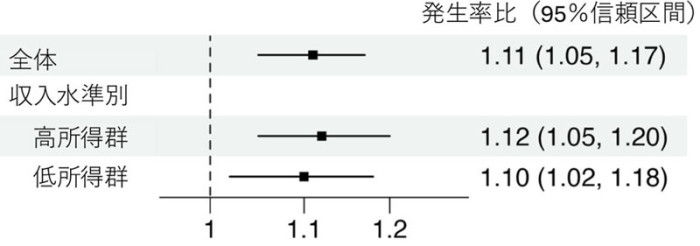
地域の社会経済的な不利と自殺の関連および個人の収入水準による違い。個人の所得水準にかかわらず、居住地域の社会経済的な不利が約11%高い自殺リスクの上昇と関係。作成:小村慶和。
<関連情報>
- https://www.kyoto-u.ac.jp/ja/research-news/2026-06-05
- https://academic.oup.com/ije/article-abstract/55/3/dyag070/8694300
地域レベルの社会経済的剥奪と自殺の関係およびその世帯所得による異質性:全国規模のコホート研究 Area-level socioeconomic deprivation and suicide by household income: a nationwide cohort study 2015–23
Yoshikazu Komura,Kosuke Inoue,Rory C O’Connor,Naoki Kondo
International Journal of Epidemiology Published:26 May 2026
DOI:https://doi.org/10.1093/ije/dyag070
Abstract
Background
Although area-level socioeconomic deprivation is a potential target for suicide prevention, it remains unclear whether its impact varies by individual socioeconomic status. We investigated whether the association between area-level socioeconomic deprivation and suicide differs by household income.
Methods
This nationwide cohort study included working-age individuals (18–74 years) covered by the Japan Health Insurance Association from April 2015 to March 2023. Area-level socioeconomic deprivation was assessed at the municipality level by using the Area Deprivation Index in Japan. The incidence rate ratio (IRR) of suicide by area-level socioeconomic deprivation was estimated according to household-income levels. The IRR was adjusted for age, sex, enrollment year, family structure, histories of physical diseases and psychiatric disorders, urbanicity, and local medical resources. Probabilistic bias analysis was applied to provide a bias-adjusted estimate with its uncertainty.
Results
Among 39 432 793 individuals (57.9% men; mean age 42.9 years), 6508 died by suicide. Area-level socioeconomic deprivation was associated with higher suicide risk, independently of covariates [IRR = 1.11, 95% confidence interval (CI) 1.05–1.17]. This association was found in both the high-household-income group (IRR = 1.12, 95% CI 1.05–1.20) and the low-household-income group (IRR = 1.10, 95% CI 1.02–1.18), with no evidence of heterogeneity. Probabilistic bias analysis supported these findings.
Conclusion
People in deprived areas experienced higher suicide risk, without heterogeneity by household income. Limitations include potential outcome misclassification, as approximately one-third of cause-of-death data were missing. Addressing area-level socioeconomic deprivation may prevent suicide, regardless of individual socioeconomic status.