2026-06-04 北海道大学
二酸化塩素ガスによる高病原性鳥インフルエンザウイルス感染からの防御
<関連情報>
- https://www.hokudai.ac.jp/news/2026/06/post-2313.html
- https://link.springer.com/article/10.1007/s12560-026-09677-3
低濃度二酸化塩素ガスによるH5高病原性鳥インフルエンザウイルスの空気感染不活化の生体内モデルによる評価 Evaluation of the Efficacy of Low-Concentration Gaseous Chlorine Dioxide in Inactivating Airborne H5 High Pathogenicity Avian Influenza Virus in Vivo Model
Yik Lim Hew,Norikazu Isoda,Takanori Miura,Takahiro Hiono & Yoshihiro Sakoda
Food and Environmental Virology Published:23 January 2026
DOI:https://doi.org/10.1007/s12560-026-09677-3
Abstract
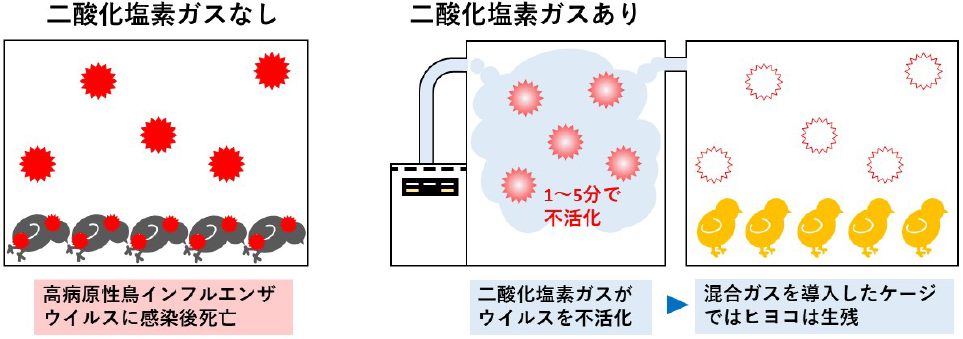
H5 high pathogenicity avian influenza virus (HPAIV) continues to spread globally, causing several high pathogenicity avian influenza (HPAI) outbreaks in poultry and significant economic losses. Biosecurity measures that prevent the introduction of HPAIV represent a top priority for controlling HPAI outbreaks on poultry farms. Although these measures are crucial for minimizing HPAI introduction, outbreaks of viral infection on poultry farms persist, underscoring the importance of continuously improving biosecurity protocols. Therefore, safe and effective microbicide disinfectants could play an essential role in reducing viral spread by inactivating viral particles on surfaces and in the air. This study assessed the efficacy of gaseous chlorine dioxide (ClO2) against H5 HPAIV under both gaseous ClO2 inactivation setting and in vivo conditions. In the gaseous ClO2 inactivation setting, only low virus titers were recovered (< 0.5–1.5 log10 TCID50/mL) when H5 HPAIV aerosols were exposed to gaseous ClO2 (0.05 ppmv, 0.14 mg/m3) for 5 min, corresponding to an approximately 2.0–3.0 log10 reduction. Furthermore, in vivo, all chicks exposed to aerosolized H5 HPAIV, which were treated with 0.1 ppmv gaseous ClO2, survived for 14 days post-challenge, demonstrating complete protection against the virus. The minimum effective concentration of gaseous ClO2 was 0.01 ppmv for 5 min of inactivation in the inactivation setting, and 0.05 ppmv for 5 min in vivo, indicating that relatively low concentrations are sufficient for effective viral inactivation. Therefore, gaseous ClO2 was effective at inactivating aerosolized H5 HPAIV and has potential for use as a disinfectant to prevent HPAIV introduction into poultry. (245/250) words.