2026-08-06 大阪医科薬科大学,東京大学,星薬科大学,日本消化器外科学会
<関連情報>
- https://www.omp.ac.jp/public/press/v0saoh0000002ypy.html
- https://www.sciencedirect.com/science/article/pii/S0039606026003661
ロボット支援手術の早期導入に伴う手術機会における性差 Sex differences in operative opportunities with early adoption of robot-assisted surgery
Emiko Kono MD, PhD, Hiroyuki Yamamoto MD, MPH, PhD, Sachiyo Nomura MD, PhD, Chie Tanaka MD, PhD, Hideki Ueno MD, PhD, Yoshihiro Kakeji MD, PhD, Ken Shirabe MD, PhD
Surgery Available online: 14 July 2026
DOI:https://doi.org/10.1016/j.surg.2026.110441
Abstract
Background
Early adoption of new surgical technologies represents a critical period for acquiring operative experience that may influence surgeons’ careers. However, whether access to operative opportunities during the introduction of robot-assisted surgery differs according to the surgeon’s sex remains unclear.
Methods
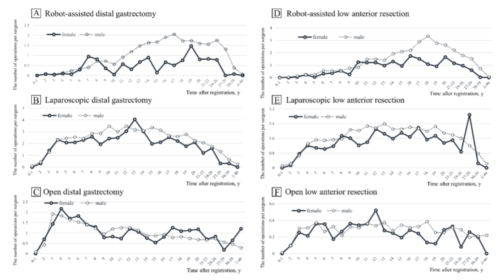
This retrospective observational study used data from the National Clinical Database, a multicenter database covering more than 95% of all surgeries in Japan. Male and female gastroenterological surgeons who performed distal gastrectomy or low anterior resection between January 1, 2023 and December 31, 2024 were included. The primary outcome was the number of operations performed per surgeon, stratified by sex and years since medical registration.
Results
A total of 47,934 distal gastrectomies and 38,230 low anterior resections were included in the analysis. For both procedures, the proportion of operations performed by female surgeons was lowest for robot-assisted surgery. For distal gastrectomy, the proportions were 4.32%, 9.47%, and 11.86% and for low anterior resection, 5.41%, 8.41%, and 8.57% (robot-assisted, laparoscopic, and open, respectively). For robot-assisted procedures, the number of operations performed per surgeon increased with years since medical registration among male surgeons, whereas no comparable increase was observed among female surgeons. Sex differences became apparent at approximately 10 years after medical registration.
Conclusion
Substantial sex-based disparities in operative opportunities were observed during the early adoption phase of robot-assisted surgery. These disparities were most pronounced for robot-assisted procedures compared with laparoscopic and open surgery. Inequities in access to newly introduced surgical technologies may contribute to persistent sex disparities in surgical careers.