2026-08-04 京都大学
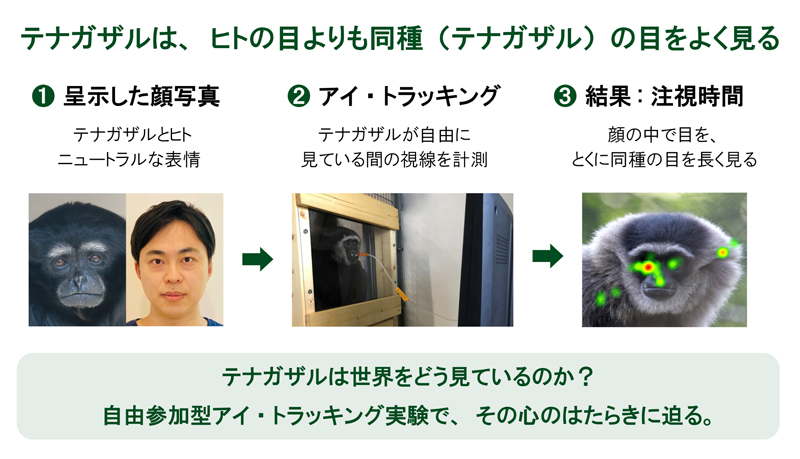
研究の概要(作成:打越万喜子、©京都大学 ヒト行動進化研究所)
<関連情報>
- https://www.kyoto-u.ac.jp/ja/research-news/2026-08-04-3
- https://www.animalbehaviorandcognition.org/article.php?id=1440
テナガザルは同種の顔の⽬をよく⾒ている― アイ・トラッキングを使⽤した研究 Gibbons (Hylobates spp.) Show Increased Attention to Eyes When Viewing Conspecific Faces: An Eye-Tracking Study
Makiko Uchikoshi,Lira Yu,Yuko Hattori
Animal Behavior and Cognition Published:August 2026
DOI:https://doi.org/10.26451/abc.13.03.02.2026
Abstract
For humans, the face is a socially important visual stimulus, and the evolution of face perception has received considerable attention in research on non-human primates. However, little is known about face perception in gibbons, a key phylogenetic group among apes and humans. To address this gap, we used an eye-tracking device to examine how gibbons view face photographs, with the participation of three male adult gibbons. A total of 48 stimuli, consisting of gibbon and human faces showing neutral expressions were presented, and the gibbons were allowed to view them freely. Areas of interest (AOI) were defined for the eyes, nose, mouth, face periphery, and background in each image. We tested the effects of the AOIs and presented face species on viewing time. In analyses pooling data across individuals, gibbons spent significantly more time viewing the eyes than any other area and viewed gibbon eyes longer than human eyes. In separate analyses for each individual, two gibbons viewed the eyes significantly longer than the nose or mouth. Longer viewing times for gibbon eyes than human eyes were observed in all individuals. These results indicate that eyes are a highly salient facial feature for gibbons, albeit variably among individuals, and that gibbons’ viewing patterns differ when looking at a conspecific or an allospecific face. These findings are consistent with face-scanning studies in macaques and great apes. Further studies are needed to confirm the generality of these results and to uncover other characteristics of gibbon face perception.
テナガザルにおけるアイ・トラッキング研究を実現 ― 視線軌跡の初測定に成功 Applying an eye tracking technique to gibbons: First study using scanpath measurements for visual stimuli
Makiko Uchikoshi, Lira Yu, Yuko Hattori
Behavioural Processes Available online: 23 July 2024
DOI:https://doi.org/10.1016/j.beproc.2024.105080
Highlights
- The feasibility of eye tracking in gibbons was demonstrated for the first time.
- Gibbons viewed images longer than background.
- Longer viewing suggests face images capture more attention for gibbons.
Abstract
Compared to the abundance of research on cognition in various nonhuman primate species, studies of gibbons — often called “the small apes” — remain limited, despite the importance of gibbons for understanding evolutionary processes in humans and other apes. Over the past decade, eye tracking techniques have been established in chimpanzees and other nonhuman primates using the free-participation method, which requires no physical restraint of the subjects. We investigated the feasibility of using the same method to record visual scanpaths in gibbons. We attempted to measure the eye movements of three adult gibbons while they spontaneously viewed images, with no prior fixation training. Calibration was successful in all three individuals, with errors of less than one degree. In total, 24 stimuli were used, with landscape and nonhuman primate face photographs presented on one-quarter of the screen, to test the prediction that gibbons would change their viewing time depending on image category. All three gibbons viewed the images for longer than the background, and primate face images for longer than landscapes. These results are consistent with previous findings in other primate species that faces attract more attention than non-face stimuli, suggesting that this effect is common across primates. This study demonstrates the feasibility of using eye tracking with gibbons. Further studies on gibbon visual exploration and cognition may enhance our understanding of the phylogenetic origins of hominid intelligence as well as the unique evolution of gibbons.