2026-08-08 沖縄科学技術大学院大学
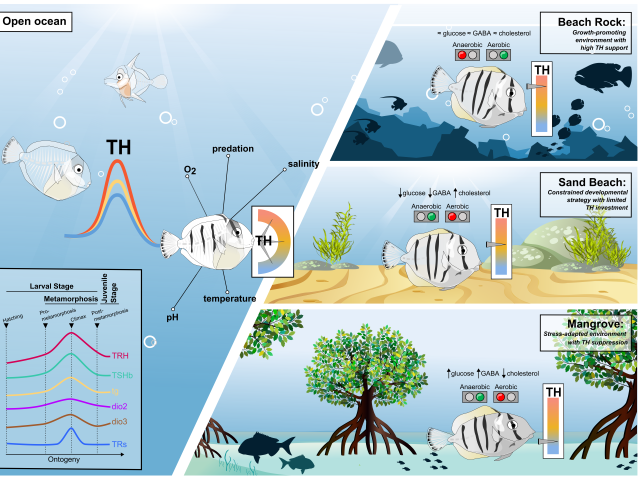
© Herrera et al., Science Advances, 2026 DOI:10.1126/sciadv.aec5359
<関連情報>
- https://www.oist.jp/ja/news-center/news/2026/8/8/hidden-hormone-habitat-relationship-revealed-reef-fish
- https://www.science.org/doi/10.1126/sciadv.aec5359
環境による甲状腺ホルモンシグナル伝達の調節が発達可塑性を促進する Environmental tuning of thyroid hormone signaling drives developmental plasticity
Marcela Herrera , Saori Miura , Zoé Chamot , Mathieu Reynaud , […] , and Vincent Laudet
Science Advances Published:7 Aug 2026
DOI:https://doi.org/10.1126/sciadv.aec5359
Abstract
Vertebrate developmental transitions unfold in environments increasingly altered by global change. Thyroid hormones, a deeply conserved endocrine axis, coordinate post-embryonic transformations, yet the effects of natural ecological variation on this signaling remain largely unexplored—despite their potential to shape developmental plasticity and acclimation to local environments. To address this, we investigated a common reef fish (Acanthurus triostegus), which undergoes a thyroid-dependent metamorphosis during settlement into coastal nurseries. By combining transcriptomic, hormonal, and metabolic profiling across distinct natural habitats, we show that settlement triggers a profound reprogramming of energy metabolism, tightly coupled to thyroid signaling. Strikingly, the magnitude and direction of thyroid hormone regulation varied with habitat, producing divergent metabolic and physiological states. These results demonstrate that thyroid hormones act not only as a developmental timer but as a dynamic integrator of environment and physiology. More broadly, they reveal a conserved mechanism of vertebrate developmental plasticity, highlighting endocrine flexibility as a potential buffer of population resilience under rapid environmental change.