2026-08-07 東京大学 ,名古屋市立大学 滋賀医科大学, 熊本大学
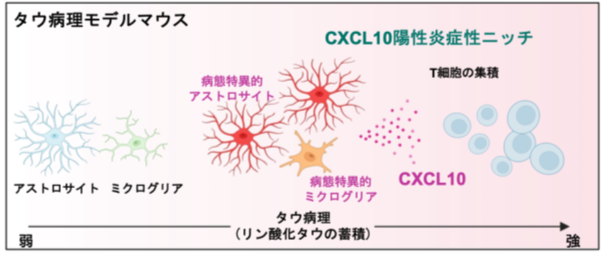
タウオパチーモデルマウスの脳内でタウ病理の強い脳領域(海馬や梨状皮質)でCXCL10が高発現することを見出した。
<関連情報>
- https://www.u-tokyo.ac.jp/content/400294142.pdf
- https://link.springer.com/article/10.1186/s12974-026-03989-8
CXCL10はタウオパチーモデルマウスにおける雌特異的な病理学的進行に寄与する CXCL10 contributes to female-specific pathological progression in tauopathy model mice
Ryohei Uenishi,Rinna Kawata,Tatsuya Manabe,Yukio Matsuba,Naomi Mihira,Toru Takeo,Takaomi C. Saido,Masanori Hijioka & Takashi Saito
Journal of Neuroinflammation Published:05 August 2026
DOI:https://doi.org/10.1186/s12974-026-03989-8
Abstract
Neuroinflammation plays a central role in the progression of tauopathy via the glial activation and T cell accumulation in the brain parenchyma. However, the key molecular mediators that link these processes to tau pathology remain poorly understood.
Here, we identify C-X-C motif chemokine ligand 10 (CXCL10) as a critical inflammatory mediator that is markedly upregulated in the brains of P301S-mutant tau transgenic mice and associated with regions of severe tau pathology. Spatial transcriptomics revealed that CXCL10 is mainly expressed by disease-associated astrocytes, defining an astrocytic CXCL10-rich inflammatory niche within the tauopathy brain.
Genetic ablation of Cxcl10 significantly attenuated soluble and insoluble tau accumulation selectively in 9-month-old female mice, whereas no attenuation of tau accumulation was observed at 11–12 months of age. In addition, Cxcl10 deficiency significantly prolonged survival specifically in female tauopathy mice. Although Cxcl10 deficiency reduced the number of parenchymal T cells in both sexes, this reduction did not explain the female-specific effects. Furthermore, Cxcl10 deficiency did not alter neurodegeneration and motor dysfunction, suggesting that downstream sex-dependent regulatory mechanisms govern tauopathy progression. Moreover, CXCL10-dependent inflammatory activation within the local microenvironments was observed in both sexes. Although the molecular mechanisms underlying the sex-dependent effects of CXCL10 remain unclear, these findings suggest that CXCL10 contributes to tau pathology through multiple inflammatory pathways.
In summary, our findings identify CXCL10 as a key inflammatory mediator of sex specific tau-associated pathology.