
2026-05-18 北海道大学
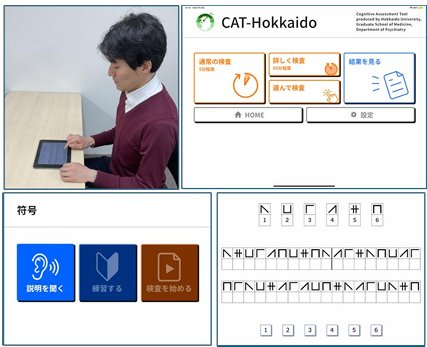
図 本研究で開発した認知機能検査アプリCAT-Hokkaidoの実施時の様子(左上)、冒頭の画面(右上)、符号課題の画面(左下、右下)
<関連情報>
- https://www.huhp.hokudai.ac.jp/wp-content/uploads/2026/05/press_20260518.pdf
- https://onlinelibrary.wiley.com/doi/10.1002/pcn5.70339
CAT-Hokkaido:統合失調症における認知機能障害のタブレットを用いた評価 CAT-Hokkaido: A tablet-based assessment of cognitive impairment in schizophrenia
Atsuhito Toyomaki PhD, Hayato Watanabe MA, Ryo Sawagashira MD, PhD, Chiemi Kubota BA, Naoki Hashimoto MD, PhD, Takahiro A. Kato MD, PhD
Psychiatry and Clinical Neurosciences Reports Published: 29 April 2026
DOI:https://doi.org/10.1002/pcn5.70339
Abstract
Aim
Cognitive impairment is a core feature of schizophrenia and is typically assessed using paper-and-pencil neuropsychological batteries. However, these traditional methods are time-consuming and place a substantial burden on examiners before, during, and after administration. To address this issue, we developed CAT-Hokkaido, a brief tablet-based cognitive assessment tool designed to assess multiple neurocognitive domains while reducing examiner burden.
Methods
We assessed its validity in a sample of 50 individuals with schizophrenia and 50 healthy controls, using the MATRICS Consensus Cognitive Battery (MCCB) as a reference standard. Group differences in CAT-Hokkaido and MCCB scores were analyzed.
Results
CAT-Hokkaido identified significant performance deficits in four out of six tasks among patients with schizophrenia. These four tests evaluated processing speed, executive function, sustained attention, and verbal learning. Additionally, all tasks demonstrated significant correlations with their corresponding MCCB measures, supporting the tool’s convergent validity.
Conclusion
These findings suggest that CAT-Hokkaido may serve as a surrogate tool for assessing cognitive impairment in schizophrenia.

