2026-08-18 京都大学
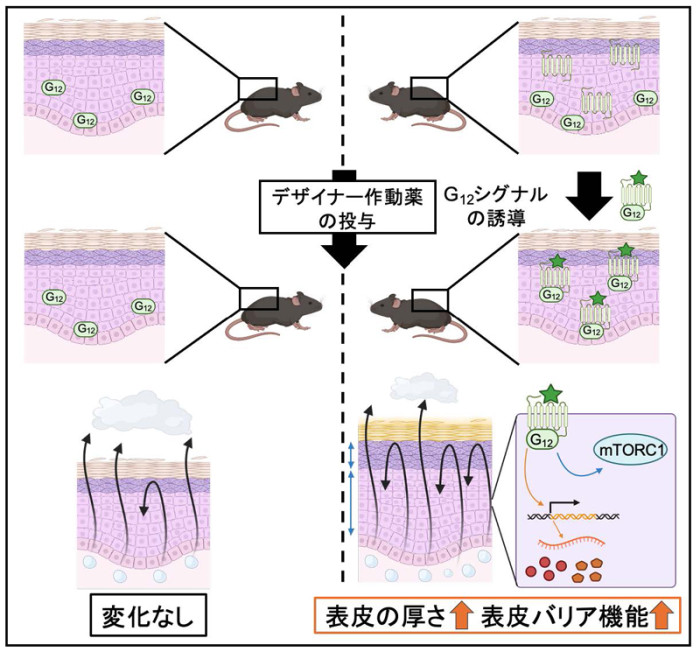
G₁₂シグナルの誘導による皮膚バリア機能の亢進。©️京都大学・薬学研究科・シグナル薬理学分野
<関連情報>
- https://www.kyoto-u.ac.jp/ja/research-news/2026-08-18
- https://faseb.onlinelibrary.wiley.com/doi/10.1096/fba.2026-00042
G12シグナルの化学遺伝学的な活性化はバリア機能の亢進を伴う表⽪の肥厚を誘導する Chemogenetic Activation of G12 Signaling Thickens the Epidermis With Enhanced Barrier Function
Nozomi Kamakura, Natsumi Hirai, Kaito Arai, Yaxin Du, Toshiaki Kogame, Yusuke Ohno, Akio Kihara, Kenji Kabashima, Asuka Inoue
FASEB BioAdvances Published: 31 July 2026
DOI:https://doi.org/10.1096/fba.2026-00042
ABSTRACT
The epidermis provides the body’s outermost barrier, yet how G-protein-coupled receptor (GPCR) signaling via the G12/13 family regulates epidermal homeostasis in vivo remains unclear. Here, we selectively activated G12 signaling in keratinocytes using a chemogenetic strategy. Activation of a G12-coupled designer receptor (G12D) in mouse epithelial cells induced pronounced epidermal thickening while preserving stratified architecture and avoiding overt inflammatory skin changes. This thickening was accompanied by increased Ki67-positive cells, expansion of keratin 10- and filaggrin-positive layers, and transcriptomic upregulation of genes related to keratinocyte differentiation, keratinization, and epidermal barrier function. Functionally, G12D activation strengthened barrier performance, as shown by blunted transepidermal water loss responses to mechanical barrier disruption. Although alarmin-related genes were upregulated, cytokine analyses indicated only modest inflammatory changes. Pharmacologic inhibition of TYK2 (deucravacitinib) partially reduced G12D-driven epidermal thickening, whereas mTORC1 inhibition (rapamycin) produced a stronger suppressive effect, suggesting that the mTORC1-dependent keratinocyte response is a major driver of this phenotype, with a moderate TYK2-dependent component. Together, these findings identify epidermal G12 signaling as a regulator that promotes “non-pathological” epidermal thickening coupled to enhanced barrier function, supporting G12-coupled GPCRs as potential therapeutic entry points for barrier-compromised skin disorders.