2026-08-18 東北大学
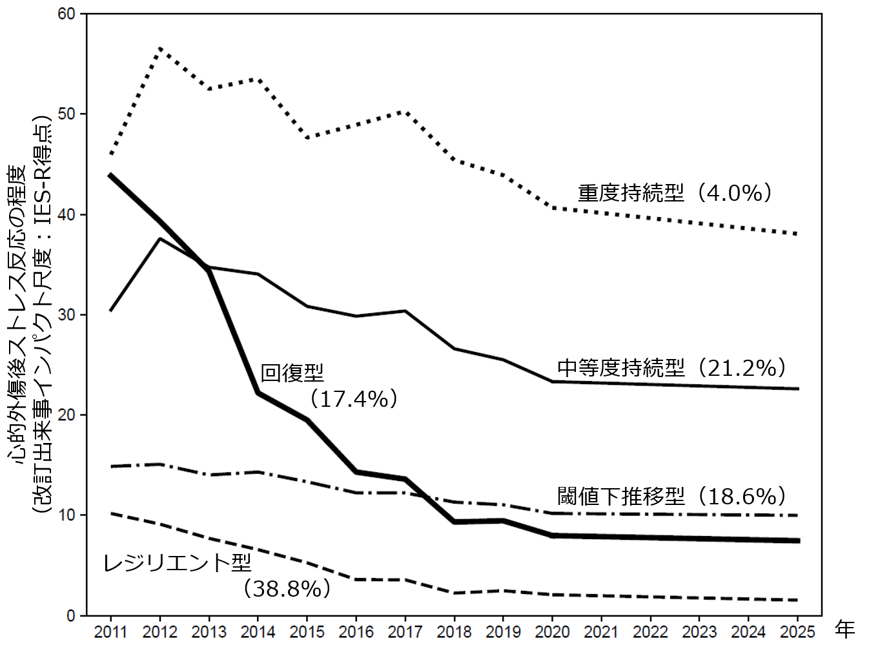
図1. 東日本大震災被災者における心的外傷後ストレス反応の15年間の推移(5つの軌跡)
<関連情報>
- https://www.tohoku.ac.jp/japanese/2026/08/press20260818-01-ptsr.html
- https://jamanetwork.com/journals/jamanetworkopen/fullarticle/2852816
東日本大震災被災者における心的外傷後ストレスの動態と15年間の持続性 Posttraumatic Stress Dynamics and 15-Year Persistence in Great East Japan Earthquake Survivors
Xue Li, PhD; Hitomi Usukura, PhD; Yusuke Utsumi, PhD;et al
JAMA Network Open Published:August 14, 2026
DOI:0.1001/jamanetworkopen.2026.29441
Key Points
Question Are early postdisaster symptom dynamics, particularly symptom escalation, associated with persistent posttraumatic stress reactions after a major disaster?
Findings In this 15-year cohort study of 1291 survivors of the Great East Japan Earthquake, symptom escalation during the first postdisaster year was associated with more than a 5-fold increase in the odds of persistent, clinically meaningful posttraumatic stress reactions, independently of initial symptom severity, sleep disturbance, resilience, age, and sex.
Meaning These findings suggest that early symptom dynamics may provide useful prognostic information to inform risk stratification and long-term mental health planning following major disasters.
Abstract
Importance Long-term persistence of posttraumatic stress reactions (PTSRs) is a major public health challenge, yet early prognostic markers for decadal outcomes remain poorly characterized. Specifically, the importance of early symptom fluctuations compared with initial cross-sectional severity is not well understood.
Objective To determine whether early postdisaster symptom dynamics within 1 year are associated with persistent, clinically meaningful PTSRs 15 years after the 2011 Great East Japan Earthquake (GEJE).
Design, Setting, and Participants This 15-year prospective longitudinal cohort study (2011-2025) included residents of Shichigahama, Miyagi, Japan, aged 20 years or older, who experienced disaster-certified housing destruction after the GEJE.
Exposures Early symptom dynamics (2011-2012) based on Impact of Event Scale–Revised (IES-R) scores and classified as (1) high-escalating (IES-R score ≥25 and increasing), (2) high-improving (IES-R score ≥25 and nonincreasing), and (3) nonpersistent early (IES-R score <25 at either wave).
Main Outcomes and Measures The primary outcomes were persistent, clinically meaningful PTSRs (IES-R score ≥25) at 15 years. Multivariable logistic regression with 40-fold multiple imputation was used to estimate adjusted odds ratios (aORs).
Results Among 1291 participants (685 women [53.1%]; mean [SD] age, 53.9 [16.6] years), group-based trajectory modeling of IES-R scores (2011-2025) identified 5 distinct PTSR patterns. At 15 years, 14.7% of participants (190 participants) had clinically meaningful PTSRs. Symptom escalation was most frequent during the first-to-second year interval compared with all subsequent periods. This trend remained consistent even under stringent escalation criteria (>5-point increase). The high-escalating pattern was the one most associated with 15-year persistence (aOR, 5.31; 95% CI, 3.85-7.32). The prognostic model incorporating early dynamics demonstrated improved discrimination (area under the curve [AUC], 0.756; 95% CI, 0.717-0.763) compared with models using baseline symptom severity alone (AUC, 0.608; 95% CI, 0.600-0.612) or delayed single-point assessments (AUC, 0.726; 95% CI, 0.663-0.738).
Conclusions and Relevance In this 15-year cohort study of GEJE survivors, symptom escalation during the first-to-second year interval was identified as the most prevalent pattern and was a factor associated with long-term persistent PTSRs. Because early symptom dynamics offer superior prognostic accuracy compared with single-point assessments, these findings support a serial screening approach during the immediate postdisaster period to optimize risk stratification and early intervention strategies.