2026-06-16 京都大学iPS細胞研究所
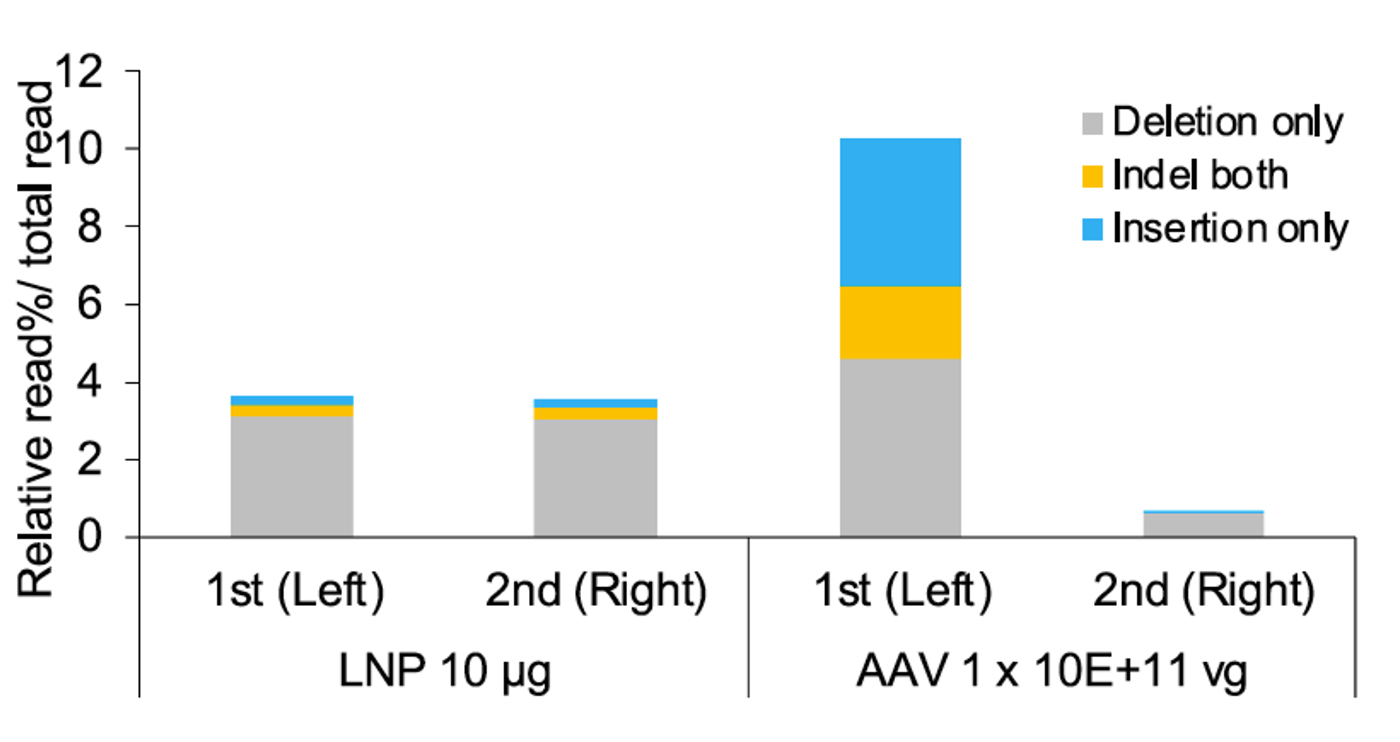
Fig. 1 マウス骨格筋においてLNPは二回投与でも効率が落ちず、配列挿入も少ない
<関連情報>
- https://www.cira.kyoto-u.ac.jp/j/pressrelease/news/260616-100000.html
- https://www.cell.com/molecular-therapy-family/nucleic-acids/fulltext/S2162-2531(26)00129-0
CRISPR-Cas9ゲノム編集の脂質ナノ粒子送達によるオンターゲットおよびオフターゲット変異誘発の包括的評価 Comprehensive assessment of on- and off-target mutagenesis via lipid nanoparticle delivery of CRISPR-Cas9 genome editing
Youichi Naoe ∙ Naoko Fujimoto ∙ Yukimasa Makita ∙ Dongyang Li ∙ Naoto Inukai ∙ Akitsu Hotta
Molecular Therapy: Nucleic Acids Published:May 20, 2026
DOI:https://doi.org/10.1016/j.omtn.2026.102958
Abstract
Ensuring the safety of CRISPR-Cas9 genome editing requires comprehensive assessment of off-target mutagenesis, particularly for therapeutic applications under regulatory review. DNA-free lipid nanoparticle (LNP) delivery is expected to minimize insertional risks compared to adeno-associated virus (AAV) vectors, but experimental validation has been limited. Here, on-target amplicon sequencing in mouse muscle demonstrated insertions largely derived from host genomic sequences, with no detectable AAV or transgene integration. Benchmarking 13 in silico prediction tools identified Cas-OFFinder as the most sensitive, though precision remained low, and correlation with in vitro CIRCLE-seq data was modest. To strengthen off-target detection, we employed karyotypically normal human iPSCs and developed an “indel cluster” method using high-depth whole-genome sequencing, enabling discrimination between clustered genome editing-induced indels and background variants. Integration of in silico predictions, CIRCLE-seq cleavage sites, and in cellulo WGS clusters yielded 11 high-confidence off-target candidates, predominantly associated with one gRNA. While sensitivity was maximized, reproducibility across conditions remained limited, and many candidate sites overlapped repetitive or low-mappability regions. Our multilayered framework demonstrates both the utility and current limitations of off-target risk assessment, providing a practical foundation for the safety evaluation of genome editing therapies.