2026-10-06 国立成育医療研究センター
<関連情報>
- https://www.ncchd.go.jp/press/2026/1006.html
- https://genesdev.cshlp.org/content/early/2026/09/18/gad.353948.126
代謝調節遺伝子Klf14のゲノムインプリンティングは、 Mestに固定された父方由来のサブTADによって制御される Genomic imprinting of the metabolic regulator gene Klf14 is regulated by a paternal sub-TAD anchored at Mest
Amanda Ha, Natsuki Hayashi, Aaron B. Bogutz, Benoit Moindrot, Laura Gomez, Juliette Harris, Alexandre Marcil, Frank Court, Miyuki Shindo, Philippe Arnaud, Jacques Drouin, Thierry Forné, Daan Noordermeer, Shuji Takada, Kazuhiko Nakabayashi, and Louis Lefebvre
Genes & Development Published:September 21, 2026
DOI:10.1101/gad.353948.126
Abstract
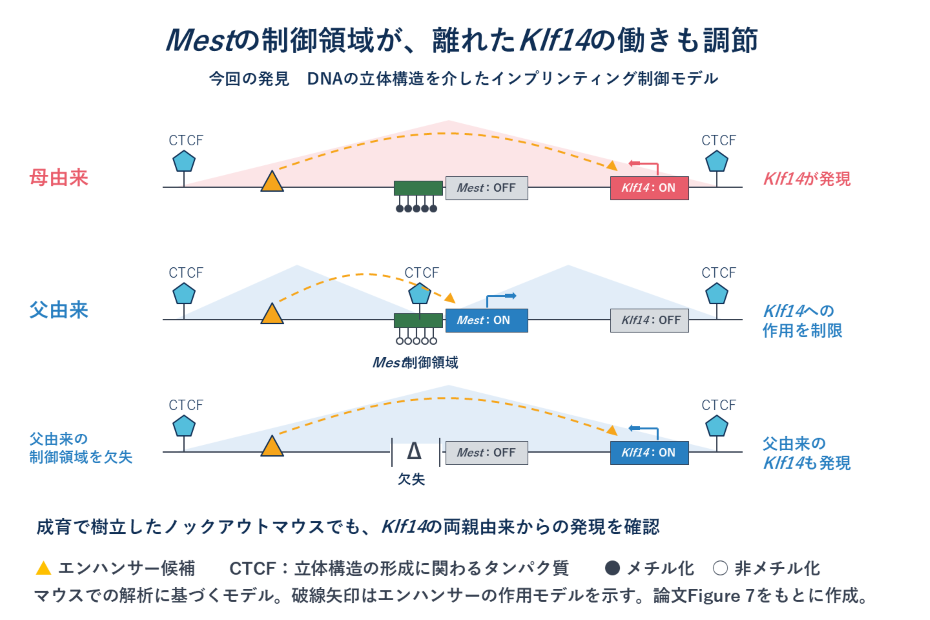
KLF14 acts as a master regulator of gene expression in adipose tissue and variants at the human KLF14 gene show reproducible association with type 2 diabetes and metabolic syndrome. Risk alleles are only pathological when maternally inherited, consistent with the observation that KLF14/Klf14 is a maternally expressed imprinted gene in human and mouse. However, how genomic imprinting is regulated at this important locus is currently unknown. In both species, KLF14/Klf14 is located ∼200 kb away from the paternally expressed imprinted gene MEST/Mest, regulated by a maternal gametic differentially methylated region (gDMR) at its promoter. Although the Klf14 promoter is unmethylated in most tissues, maternally inherited DNA methylation marks are paradoxically required for Klf14 expression. Here, we show that Mest and Klf14 reside within the same topologically associating domain (TAD) in embryonic stem cells (ESCs), defined by biallelic CTCF binding at the boundaries. Using allele-specific 4C-seq, we show that CTCF binding to the unmethylated Mest gDMR generates a paternal allele-specific sub-TAD encompassing Klf14. CRISPR–Cas9 deletions of the paternal Mest promoter region in ESCs and in vivo in mutant mice result in loss of Mest expression and acquisition of biallelic expression at Klf14. By analyzing epigenetic marks and chromatin looping in Klf14-expressing pituitary cells, we identify a putative enhancer element shared by Mest and Klf14, providing a mechanistic model for the regulation of Klf14 imprinting. This work defines a new role for the Mest maternally methylated gDMR, revealing that it exerts long-range effects via allele-specific modulation of TAD structures and acts as an imprinting control region in the regulation of Klf14 imprinting.