2026-04-20 スイス連邦工科大学ローザンヌ校(EPFL)
<関連情報>
- https://actu.epfl.ch/news/lighting-up-the-organizers-of-the-cell-s-architect/
- https://www.nature.com/articles/s41589-026-02186-1
中心体および繊毛を標識するための蛍光プローブCenSparkの開発 Development of the fluorescent probe CenSpark for labeling centrioles and cilia
Cédric Pourroy,Georgios N. Hatzopoulos,Luc Reymond,Friso E. Douma,Tatiana Favez,Marie Croisier,Sara Cascais,Caroline Arber,Benita Wolf,Daphne M. Laan,Guillermina R. Ramirez-San-Juan,François Kuonen,Saishree S. Iyer,Ilya Grigoriev,Anna Akhmanova & Pierre Gönczy
Nature Chemical Biology Published:15 April 2026
DOI:https://doi.org/10.1038/s41589-026-02186-1
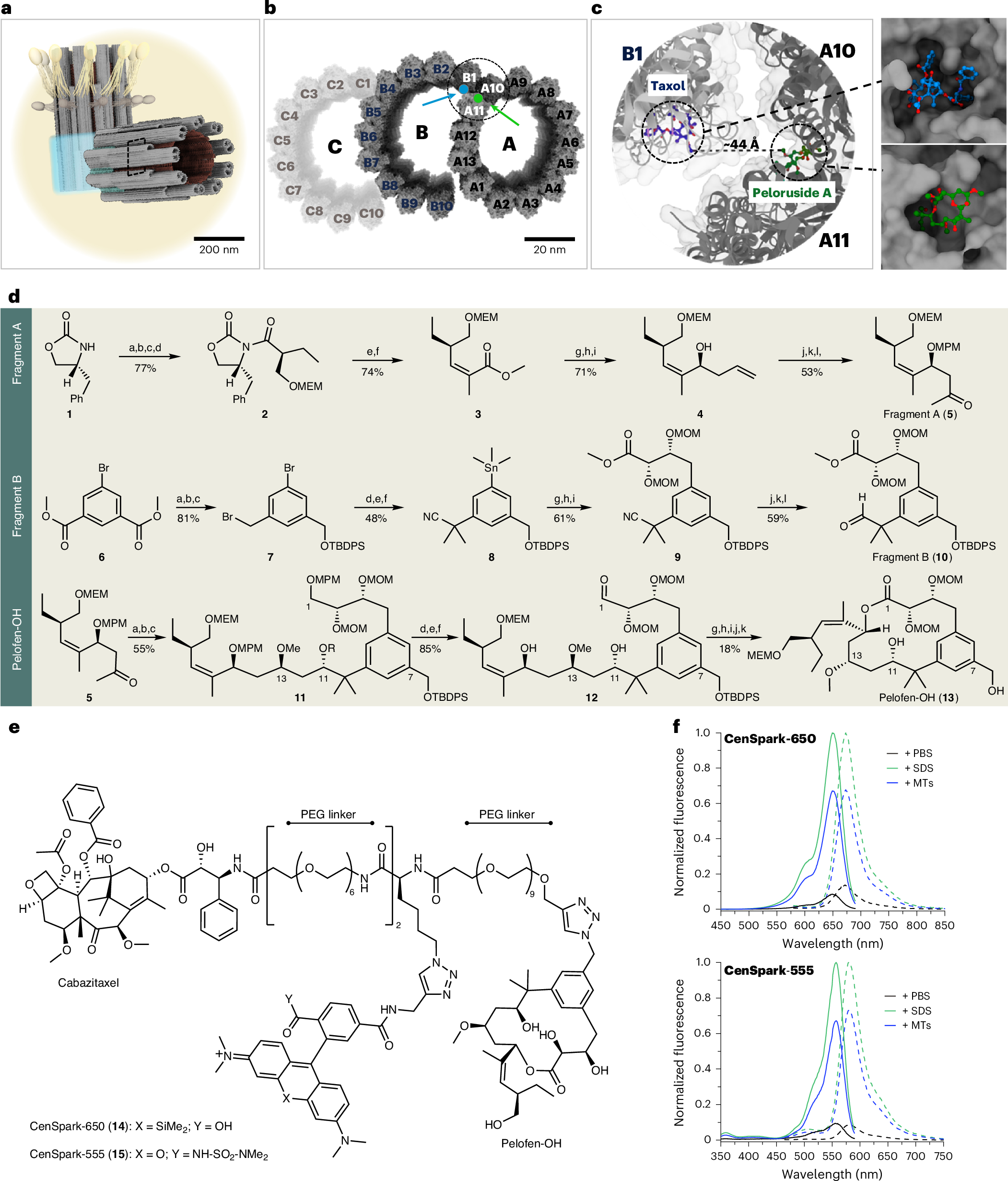
Abstract
Small-molecule probes are transformative for cell biology, offering unprecedented insights into subcellular structures, including in systems without molecular genetic tools. Centrioles are fundamental for generating the axoneme of cilia and flagella, as well as centrosomes, but a generic small-molecule probe allowing selective visualization of centriolar and axonemal microtubules is lacking. We engineered CenSpark as a cell-permeable dual-ligand fluorescent probe exploiting the juxtaposition of inner and outer microtubule-binding sites of microtubule triplets and doublets present exclusively in centriolar and axonemal microtubules. This design endows CenSpark high selectivity in live and fixed specimen analysis of centrioles, cilia and flagella across systems. We deployed CenSpark to uncover the rate of primary cilium formation and track centrioles in chimeric antigen receptor T cells during polarization at the immunological synapse with unprecedented resolution. Overall, CenSpark is a novel versatile small-molecule fluorescent probe to monitor centrioles, cilia and flagella without the need for genetic manipulation.