2026-04-21 ロイヤルメルボルン工科大学(RMIT)
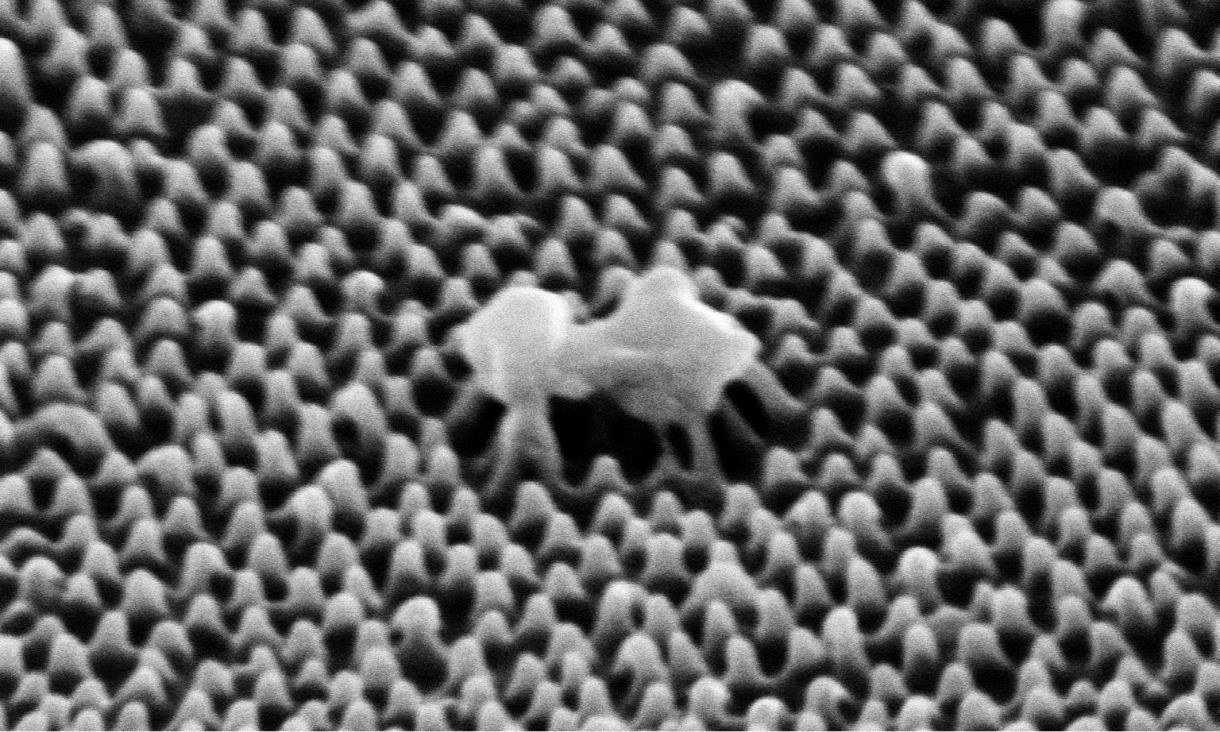
Microscope image of a virus cell being ruptured by the nanotextured surface. Image: supplied
<関連情報>
- https://www.rmit.edu.au/news/all-news/2026/apr/antiviral-texturing
- https://advanced.onlinelibrary.wiley.com/doi/10.1002/advs.202521667
ウイルス不活化効果を高めるための、拡張可能な機械的殺ウイルス性ナノ構造アクリル表面の設計 Designing Scalable Mechano-Virucidal Nanostructured Acrylic Surfaces for Enhanced Viral Inactivation
Samson W. L. Mah, Denver P. Linklater, Vassil Tzanov, Chaitali Dekiwadia, Sergey Rubanov, Phuc H. Le, Laleh Tafakori, Ranya Simons, Graeme Moad, Soichiro Saita, Takashi Yanagishita …
Advanced Science Published: 13 February 2026
DOI:https://doi.org/10.1002/advs.202521667
ABSTRACT
The transmission of viral pathogens via contaminated surfaces remains a critical public health concern, particularly in shared environments. Conventional antiviral coatings incorporating biocidal compounds face limitations due to cytotoxicity, environmental persistence, degradation, and the risk of promoting antiviral resistance. Nanostructured mechano-bactericidal surfaces have proven effective in preventing bacterial colonization, motivating exploration of their antiviral potential. In this study, flexible nanostructured acrylic films with nanopillar arrays are fabricated using anodized aluminum oxide (AAO) molds and ultraviolet nanoimprint lithography (UV-NIL), providing a scalable mechano-virucidal platform, capable of physically rupturing viral particles. Systematic variation of nanopillar pitch and height reveals that interpillar spacing is the dominant determinant of antiviral efficacy. Dense arrays with a 60 nm pitch reduce human parainfluenza virus type 3 (hPIV-3) infectivity by up to 1.2-log (∼94%) within 1 h. Finite element method (FEM) simulations demonstrate that these arrays generate localized stresses exceeding the estimated ∼10 MPa rupture threshold of the viral envelope. In contrast, increasing the pitch to 100 nm results in diminished antiviral activity that is influenced by nanopillar height, while a 200 nm pitch abolishes antiviral activity. These findings offer a chemical-free, mechano-virucidal strategy for scalable antiviral surface protection across healthcare, consumer, and environmental applications.