2026-05-28 産業技術総合研究所
<関連情報>
- https://www.aist.go.jp/aist_j/press_release/pr2026/pr20260528_2/pr20260528_2.html
- https://link.springer.com/article/10.1007/s00253-026-13845-7
アスペルギルス・オリゼにおける多重組換えによる63kb長の生合成遺伝子クラスターのワンステップ生体内構築 One-step in vivo assembly of a 63 kb-long biosynthetic gene cluster via multiple recombination in Aspergillus oryzae
Koichi Tamano,Haruka Takayama,Ikuko Kozone,Yukiko Abe,Akio Kanda,Kei Kudo,Hikaru Suenaga & Kazuo Shin-ya
Applied Microbiology and Biotechnology Published:07 May 2026
DOI:https://doi.org/10.1007/s00253-026-13845-7
Abstract
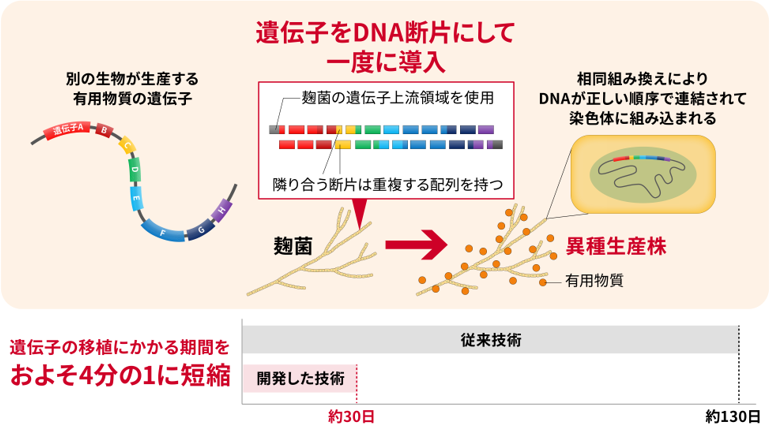
Mass production of numerous secondary plant and microbial metabolites is crucial, given their value as pharmaceutical agents, dietary supplements, and pesticides. For microbial strain, mass production generally involves improving the native producer strain to enhance overall productivity via spontaneous mutagenesis or genetic modifications. Alternatively, productivity can be enhanced through heterologous production, in which the biosynthetic genes for a secondary metabolite are expressed in a more suitable strain. However, as these biosynthetic genes commonly exist as long clusters, often exceeding several tens of kilobases (kb), their handling is labor-intensive and time-consuming, requiring multiple rounds of genetic cloning and introduction into the host. Therefore, methods enabling efficient transfer of biosynthetic genes into another microorganism in a single step of transformation without the need to clone long gene clusters have been strongly desired. Such an approach has been explored in filamentous fungi, however the maximum gene size sufficiently transferred with the approach thus far is only approximately 20 kb. In this study, we transferred 63 kb pairs of DNA encoding a secondary metabolite-biosynthetic genes into the chromosome of Aspergillus oryzae, a filamentous fungus, using a single-step transformation approach based on multiple homologous recombination events. This study expands the potential of using A. oryzae as a host for efficient heterologous metabolite production. The results serve as a useful reference, providing insights, such as the DNA fragment number and assembled cluster length in host cells, for the cases where heterologous production of a secondary metabolite proves desirable in filamentous fungi.
Key points
• One-step transfer of 24 DNA fragments to A. oryzae and the in vivo ordered assembly.
• The assembled 63 kb DNA region enabled heterologous secondary metabolite production.
• The transfer method adopted in this study may be applied to other filamentous fungi.